On this page
- Do chickens need light in the coop to lay in winter?
- Why are my chickens not laying eggs in winter?
- How many hours of light do laying hens need?
- Should the light come on in the morning or the evening?
- How bright should a chicken coop light be?
- Plug-in light with a timer or a solar coop light?
- Mistakes that stop eggs instead of adding them
- Does a coop light keep chickens warm?
A chicken coop light keeps hens laying through winter by stretching the day to 14 to 16 hours, the range University of Arizona Extension gives for peak production. Put it on a timer, switch it on before sunrise and let the hens go to roost with the real sunset. This page covers the hours, the timing, the bulb and the mistakes that stop eggs instead of adding them. It is part of the winter coop guide.
Short answer
14 to 16 hours of lightdaylight plus coop light, per Arizona, Maine and Penn State Extension
Set a timer so a warm LED comes on early enough in the morning to reach 14 hours in total. Never go past 16 hours, never cut the day short once hens are laying, and keep the nest boxes dim.
The short version
- Short days, not cold weather, cause the winter drop in laying (University of Arizona Extension).
- Arizona, UMaine and Penn State Extension all put the target at 14 to 16 hours of light a day.
- Add the light before sunrise. Dim any evening light over 30 to 45 minutes (Arizona).
- One 9 watt warm LED lights about 200 square feet of coop and run (Arizona).
- Miss a day of light and production drops. A two-day power cut can start a molt (UMaine).
- Give pullets from 8 to 20 weeks no extra light (Arizona).
Do chickens need light in the coop to lay in winter?
They need long days, and in most of North America winter days are too short. Cold weather does not stop laying; that is a misconception. Light reaching the pineal gland drives the laying cycle, so the shorter days of fall and winter cause the drop (University of Arizona Extension). Birds slow down in autumn because of light, not weather or feed, and the fix is one bulb on a timer (Texas A&M AgriLife).
Eleven to 12 hours of light starts egg production but does not sustain it, so switch the lights on when natural day length falls below 15 hours (UMaine Extension). In much of the northern US and Canada that happens by early fall.
A light is a choice, not a requirement. Hens that rest through winter are not sick. If you want eggs from November to February, though, the coop light is the tool extension services point to, and a heater is not. The chicken coop heater guide explains why heat on its own does not bring laying back.
Why are my chickens not laying eggs in winter?
Short days are the usual reason. When hens get proper care, the most common reason laying drops is a cut in light (Mississippi State Extension). Hens still lay in winter, just fewer, and extra light raises the winter count but not the total for the year (Merck Veterinary Manual). If a coop light is not the answer, or the eggs stopped anyway, work down this list:
- Days shorten from June 22 to December 22, and that change makes hens molt and stop laying for what can be several months (Oregon State Extension). The hours table below shows how much light to add.
- Most hens stop laying until a molt is over (Mississippi State), and the chicken molting in winter guide covers how long that takes.
- Too little energy, protein or calcium can stop laying, and whole grains, scratch and table scraps unbalance a layer diet (UF/IFAS Extension). The winter feeding guide covers what to feed in the cold.
- Hens react to a lack of water faster than a lack of feed, and a few hours without water will probably cut laying (UF/IFAS). A waterer that freezes overnight does exactly that, so read the keep chicken water from freezing guide.
- Chickens lay well until 2 to 3 years old, and then production declines (Oregon State).
- A broody hen stops laying, so collect eggs every day and keep her off the nest for a few days if she stays put (Oregon State).
- Moving, handling, fright and a lack of feed or water are all stresses that can stop laying (Oregon State).
A drop in laying is often the first sign of disease, and lethargy, lameness, coughing or a dull look follow (Oregon State). If birds look sick, skip the list and call a vet.
How many hours of light do laying hens need?
Fourteen to sixteen hours a day, counting daylight. The sources line up:
| Source | Hours of light | Upper limit | Bulb guidance |
|---|---|---|---|
| University of Arizona Extension (January 2026) | 14 to 16 | Over 16 hours adds no eggs; no 24 hour light | 60 W incandescent or 9 W LED per 200 sq ft, warm color |
| UMaine Extension, Bulletin 2227 | 14 to 16 (some breeders use 16 to 17) | Over 17 to 18 hours may depress production | 60 W, 14 W fluorescent or 9 W LED per 200 sq ft of floor |
| Penn State Extension | 14 to 16 | Never shorten the light period on laying birds | One 25 to 40 W bulb per 100 sq ft, above feed and water |
| UVM Extension, Bulletin 2217 | 14 to 16 | No advantage past 16 | 60 W incandescent or comparable LED at 7 ft for 200 sq ft |
| Texas A&M AgriLife | At least 12 to start, 16 is optimum | Not stated | Warm wavelength bulb above feeders and waterers |
Sources checked October 24, 2026. The Penn State wattage figure dates from incandescent bulbs, so read it as a light level, not a power rating.
To work out your own schedule, look up your sunrise and sunset, subtract the daylight from 14 hours, and set the timer to switch on that much earlier than sunrise. Arizona’s own Flagstaff table, for example, has 9 hours 36 minutes of daylight in mid-December and switches the light on at 3:05 AM to reach 14 hours. Move the start time every couple of weeks as sunrise moves.
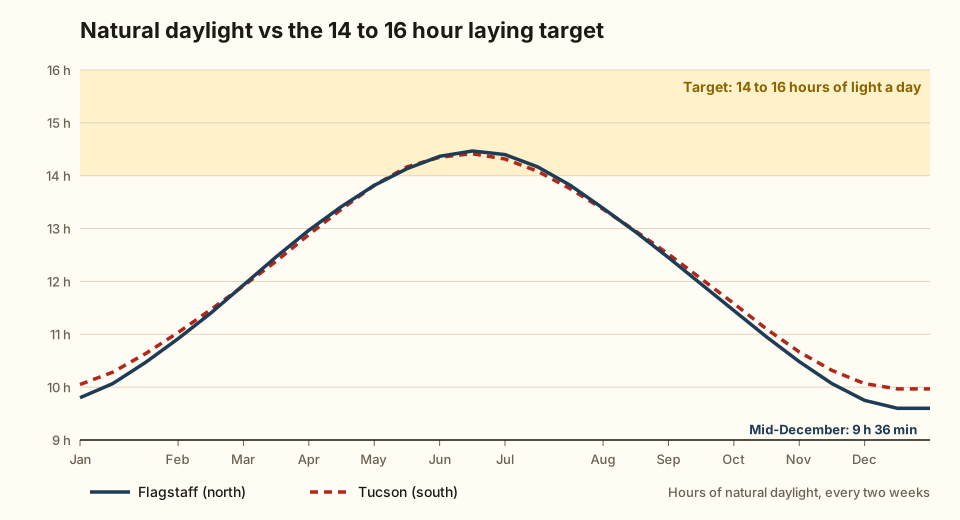
Swipe sideways to see the whole figure, or open it full size.
Should the light come on in the morning or the evening?
Morning. Add the light entirely before sunrise if you can, so hens roost with the natural sunset. If you add light after sunset, dim it gradually over 30 to 45 minutes (Arizona). Hens have poor night vision and need a gentle change to find the roost. Morning-only light lets birds go to roost naturally, while a split schedule saves a little electricity but needs a dimmer (UMaine).
An early start has a cost. Lights at 5 AM mean someone brings fresh water early, because hens should not go more than an hour without a drink after the lights come on (UMaine). The keep chicken water from freezing guide helps with that part.
How bright should a chicken coop light be?
Brighter is not better. One 9 watt LED, about the light of a 60 watt incandescent, covers roughly 200 square feet of floor (Arizona and UMaine). A 60 watt incandescent gives at least 800 lumens. Aim for about 1 foot-candle at the height of the feed trough, and if hens seem nervous and flighty, drop to a smaller bulb (UMaine).
Color matters more than watts. Use a warm, red-orange bulb rather than a cool white one, because warm light does more to stimulate laying (Arizona, UMaine and Texas A&M). Hang the light above feeders and waterers, keep the nest boxes unlit, and avoid dark corners that invite floor laying (Texas A&M). A dark curtain over nest box entries helps (UMaine). The nesting box dimensions guide covers where boxes go so they stay dim.
Keep the bulb clean. Dusty bulbs lose a real amount of light, so wipe them every month (UMaine and Arizona). In a coop, dust builds up fast.
Plug-in light with a timer or a solar coop light?
A plug-in light on a timer is the setup every source above describes. UMaine calls an automatic timer “really a necessity,” so check it weekly. An inexpensive time clock turns the lights on in the morning (Penn State). Keep the day length the same every day.
Solar coop lights with built-in timers are sold for coops without power. No extension source in this research tests them. Before buying one, check the maker’s specs for battery capacity, panel size and timer modes, and compare the panel’s position with your winter sun. A missed day of light drops production, and a solar battery that runs flat in a cloudy week does exactly that. The solar door guide explains why winter shade and short days are hard on small solar panels.
If you run power to the coop, do it properly. Make sure the wiring meets safety and local codes before you install any fixture (UMaine). The chicken coop heater guide covers outlets and cords for coops.
Mistakes that stop eggs instead of adding them
Cutting the day short is the big one. Laying birds must never see a drop in day length. Forget the lights for one day and production falls, and a power cut of two days or more can push birds into a molt that affects laying for up to six weeks (UMaine). Stopping or starting a program abruptly, or missing a day or two, can cause a temporary drop or a molt lasting 6 to 8 weeks (Arizona).
Too much light is the next. Never leave lights on around the clock; more than 16 hours of light does not bring more eggs (Arizona). Cap laying hens at 16 hours of daylight so they stay calm while forming shells at night (Manitoba Agriculture).
Lighting young birds is the third. Keep pullets on naturally declining light from 8 to 20 weeks, because early laying leads to prolapse and smaller lifetime production. Restart lighting at 18 weeks and add only 15 to 30 minutes a week until you reach 14 hours (Arizona). A jump from 10 hours of light to 13 in a single day confuses the birds, so step up 15 minutes a week (UMaine).
Using a heat lamp as the light is the last. A coop that protects birds from the weather does not need one, and heat lamps carry a large fire risk (Arizona). A heat lamp left on 24 hours reads to hens as continuous daylight, so turning it off in spring looks like a shorter day and cuts laying (UMaine). The heating a chicken coop guide covers whether you need heat at all.
Feed and calcium still matter
Supplemental light is safe for hens as long as they get balanced nutrition, especially enough calcium for shells (Arizona). If shells turn thin once the light goes on, read the oyster shell for chickens guide and ask your vet if birds look unwell.
Does a coop light keep chickens warm?
No, and it should not try to. A 9 watt LED makes almost no heat, which is the point. Cold tolerance comes from dry air, no drafts and deep bedding, which the how cold is too cold for chickens guide and the ventilation guide cover. If you decide to add heat, keep it separate from the light so you can switch the heat off in spring without changing the day length.
Questions people ask
Do chickens need a light in the coop to lay in winter?
Not to survive, but most hens slow down or stop laying without one. Shorter daylight, not cold, causes the winter drop, and hens need 14 to 16 hours of light a day for peak production (University of Arizona Extension). A coop light on a timer fills the gap.
How many hours of light do laying hens need?
Fourteen to sixteen hours a day, counting daylight and the light you add. University of Arizona, University of Maine and Penn State Extension all give that range. More than 16 hours brings no extra eggs (Arizona), so cap it at 16 (Manitoba Agriculture).
Should the coop light come on in the morning or at night?
In the morning. Add the light before sunrise so hens go to roost with the natural sunset. If you add evening light, dim it over 30 to 45 minutes (Arizona Extension). Hens see poorly in the dark and need time to find the roost.
What kind of bulb is best for a chicken coop?
A warm-colored LED. Warm, red-orange light stimulates laying better than cool light (Arizona and Texas A&M Extension). One 9 watt LED, the same light as a 60 watt incandescent, covers about 200 square feet of coop and run (Arizona).
Can I use a heat lamp as a coop light?
No. A coop that shelters birds from the weather does not need a heat lamp, and heat lamps carry a large fire risk (Arizona Extension). A heat lamp left on all night also counts as a 24 hour day to the hens (UMaine). See the chicken coop heater guide for safer heat.
Should young pullets get extra light?
No. Keep pullets from 8 to 20 weeks on naturally declining light, because early laying leads to prolapse, and restart the light schedule at 18 weeks (Arizona Extension). Do not let pullets start laying before 17 or 18 weeks (UMaine).
Sources
- Oregon State University Extension: Why did my chickens stop laying? (PNW 565, reviewed 2023)
- Mississippi State University Extension: Why do hens stop laying eggs?
- UF/IFAS Extension: Factors Affecting Egg Production in Backyard Chicken Flocks (PS029)
- Merck Veterinary Manual: Laying and Reproduction in Backyard Poultry
- University of Arizona Cooperative Extension: Lighting Schedules for Arizona Backyard Laying Flocks (az2185, January 2026)
- University of Maine Cooperative Extension: Bulletin 2227, Lighting for Small-Scale Flocks
- Texas A&M AgriLife Extension: Lighting for Backyard Chickens (POSC-PU-041)
- Penn State Extension: Management Requirements for Laying Flocks
- University of Vermont Extension: Bulletin 2217, Winter Care of Your Laying Hens
- Manitoba Agriculture: Weak Shelled Eggs and Your Small Flock of Laying Hens

Written by Kyle
Kyle has kept backyard chickens on his own small farm for five years. He reads the extension research, the spec sheets and the owner complaints, then tells you what he would buy and what he would skip.