On this page
The best solar powered automatic chicken door is the Chickcozy Solar, at $159.00. Its product page lists a self-lock, a touch sensor and a 2-year warranty, and its spec page lists a 6.5 ft cable that should let you place the panel away from the door. But any solar door only works if the panel sees winter sun. Pick solar when you have a clear southern spot for the panel in December. Otherwise buy a battery or plug-in door and skip the guessing.
Below you get three solar doors compared on price and published specs, a winter shading guide, and a plain look at solar against battery and mains. For every door type ranked together, see the best automatic chicken coop doors. For the ways any door can fail, read why automatic coop doors fail. The automatic coop doors hub lists the rest.
Quick picks
Prices were checked on each maker’s own site on 2026-10-09. “Not stated” means the product page I read does not say. No maker publishes panel wattage, so ask before you buy.
| Door | Price (checked 2026-10-09) | Panel | Battery | Lock | Obstacle sensing | Warranty |
|---|---|---|---|---|---|---|
| Chickcozy Solar | $159.00 | Wattage not stated; 6.5 ft (2 m) cable on the spec page | Built-in 3200 mAh rechargeable | Self-locks | Touch sensor, reopens | 2 years |
| Run-Chicken Eternal | $149.90 | Cell built into the drive unit; wattage not stated | Rechargeable, type and capacity not stated | Motor lock | Anti-pinch, reverses | Lifetime support, no term stated |
| ChickenGuard Pro Kit Solar | $189.98 | Wattage not stated | 4 NiMH rechargeable, or 4 AA alkaline | Says it stops lifting; separate lock kit sold | Not stated | 3 years (homepage) |
How I chose these doors
I picked solar doors by the one thing that decides whether solar works: can you put the panel where the winter sun is? That ranks panel placement above price. I read each maker’s product page, checked current prices, and collected owner reports from Reddit and YouTube comments, which I link. These are my reads of specs and reports, not bench results. I also checked the same safety basics as the main roundup: a lock, obstacle sensing and a schedule that does not need Wi-Fi.
The best solar doors
Chickcozy Solar: best solar overall
The Chickcozy costs $159.00 (regular price $169). The panel and a built-in 3200 mAh rechargeable battery run the motor, and the door opens from the center to the sides, self-locks, and stops and reopens when its touch sensor meets resistance. The homepage lists -20°F to 140°F, and the warranty runs 2 years. The spec page lists a 6.5 ft (2 m) cable, so measure from your sunniest spot to the door before you order.
Chickcozy publishes neither panel wattage nor how long a full charge lasts. I found no owner reports tied to this exact model, so its winter record is unknown.
Chickcozy Solar Automatic Chicken Coop Door
a coop with a clear panel spot in full winter sun
- Power
- Solar panel plus built-in 3200 mAh rechargeable battery
- Cable
- 6.5 ft (2 m) listed on the spec page
- Opening
- 8.25 × 10.4 in; opens from the center to the sides
- Modes
- Timer, light, manual
- Lock
- Self-locks once closed
- Obstacle sensing
- Touch sensor, stops and reopens
- Rated range
- -20°F to 140°F
- Warranty
- 2 years
- Spec page lists a 6.5 ft cable, so the panel may sit away from the door
- Self-lock and touch sensor both listed
- Widest stated temperature range of the three
- No batteries to swap
- Panel wattage and runtime without sun not published
- No owner reports found for this model
- Opening is small for large breeds
Run-Chicken Eternal: lowest solar price
Run-Chicken’s Eternal costs $149.90, the lowest of the three. It has the same 8 × 10 in opening as the T50, a motor lock and anti-pinch that stops and reverses on resistance, and the same sunrise and sunset, timer and app modes. The catch is the panel: the page says the solar cell is built into the drive unit. You cannot move it to a sunnier spot, so the door must sit where the light is.
The battery details conflict too. One line says more than 5 years before replacement and another says to replace batteries about once a year. The page gives no numeric temperature rating, only that the door is designed to withstand heat, cold, snow and icing.
Run-Chicken Eternal
a coop where the door itself sits in full winter sun
- Power
- Solar cell built into the drive unit, rechargeable batteries
- Opening
- 8 × 10 in; door 9.5 × 14 in; full open height 24 in
- Modes
- Sunrise and sunset, timer, manual app control
- Lock
- Motor-locking system
- Obstacle sensing
- Anti-pinch, stops and reverses
- Warranty
- Lifetime customer support, no term stated
- Lowest price of the three solar doors
- Motor lock and anti-pinch both listed
- Offsets adjustable up to 60 minutes
- Cell is part of the drive unit, so it cannot be repositioned
- Battery life statements conflict on the page
- No numeric temperature rating
What owners report
A commenter on a Chicken Fans door roundup says their Run-Chicken E50 lasted a year and 8 months before it died. The commenter does not say whether the E50 is the Eternal.
ChickenGuard Pro Kit Solar: best with a mains fallback
ChickenGuard lists the Pro Kit Solar at $189.98, the most expensive of the three. Its page lists batteries and 9 V mains as alternatives to the panel, which neither of the other two pages does, so a shaded winter does not leave you stranded. The solar kit uses 4 NiMH rechargeable batteries, the opener lifts doors up to 2 kg, and the four modes are light sensor, timer, manual and Dualsafe. The page says the opener prevents predators lifting the door, and ChickenGuard sells a separate Self Locking Door Kit, so ask which lock parts come in the box. ChickenGuard’s homepage lists a 3-year warranty.
The page does not state panel wattage, battery capacity or obstacle sensing, and it does not make clear whether a door ships in the box. Check the contents before you order.
ChickenGuard Pro Kit Solar
a coop with some sun that also has an outlet or spare batteries
- Power
- Solar panel with 4 NiMH batteries, or 4 AA alkaline, or 9 V 1A DC mains
- Modes
- Light sensor, timer, manual, Dualsafe
- Lifts
- Doors up to 2 kg
- Lock
- Page says it prevents lifting; separate Self Locking Door Kit sold
- Warranty
- 3 years (ChickenGuard homepage)
- Obstacle sensing
- Not stated
- Three power options, so shade is not fatal
- Longest warranty of the three
- Four modes, none needing an app
- Most expensive of the three
- Panel wattage and battery capacity not stated
- Unclear whether a door is included
Will solar work in winter?
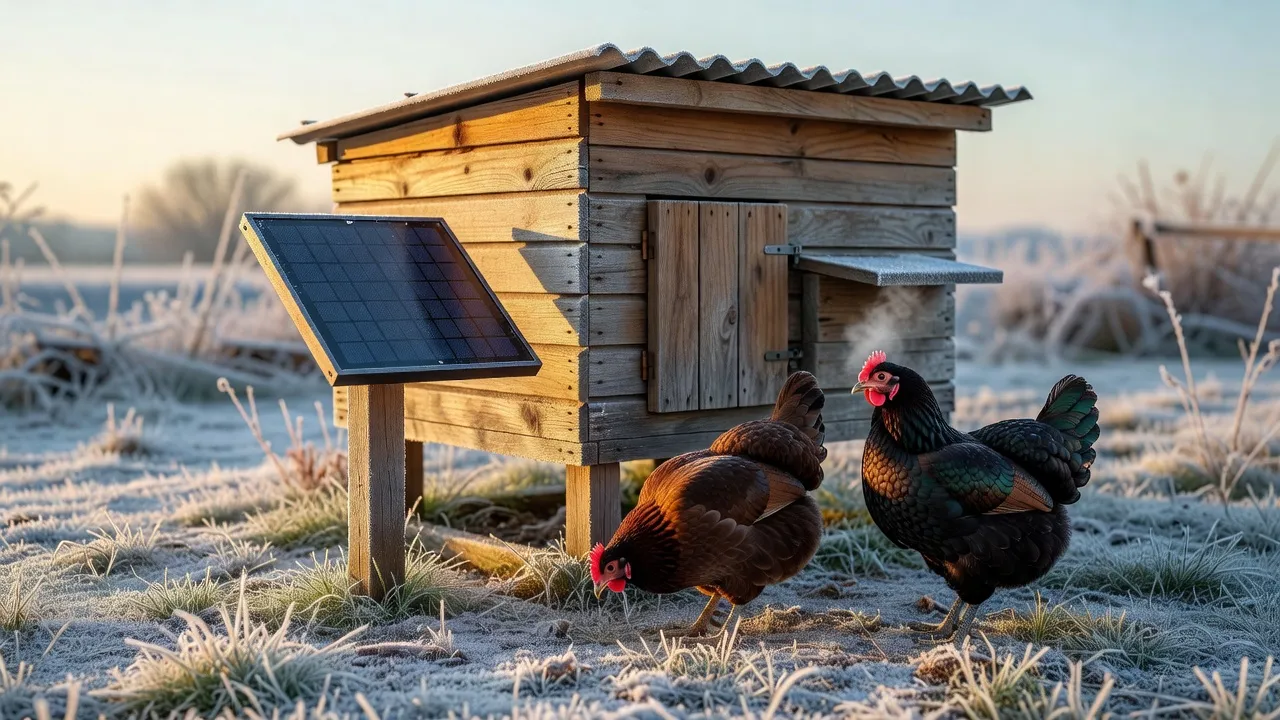
Solar works in winter only when the panel sees the sun on short, low-sun days. A panel that gets full light in July can sit in the shade of an eave, a tree or a run roof in December. The owner reports follow that pattern. One commenter on a solar door install video says their door stopped working once it got colder, after they built a run over it so the panel got little sun. Another says their first door stopped after seven months for no reason they could find, and they regret buying a second.
Keepers keep asking the same question in r/BackYardChickens: battery or solar panel? Here is how I would settle it.
- Find the December sun. Stand at the coop on a clear winter morning and note where the sun clears the trees and the roofline. If no spot gets sun from late morning to mid-afternoon, buy a battery door.
- Aim the panel south and tilt it steeper. In the Northern Hemisphere, a south-facing panel catches the most winter light, and a steeper tilt suits the low winter sun. I found no extension or lab source for an exact winter angle, so check the maker’s mounting instructions before you pick a number.
- Keep snow and shade off it. A steeper tilt helps snow slide off. Trim branches and keep run roofs out of its path.
- Measure the cable. A 6.5 ft panel cable limits where the panel can go. A cell built into the motor, as on the Eternal, cannot move at all.
- Keep a backup. Spare batteries or a mains option let you ride out a gray week.
What to ask the maker before you buy
The product pages for all three doors leave out the numbers that decide winter performance. Email the seller with these questions, and treat a vague answer as an answer:
- How many watts is the panel, and can it charge through glass? If you plan to mount it behind a coop window, ask whether the maker supports that.
- How many days does a full charge run the door with no sun at all?
- What is the battery chemistry and size, and is it replaceable? ChickenGuard names NiMH cells. Chickcozy gives 3200 mAh but no runtime. Run-Chicken names neither.
- What happens at a low charge? A door that stops halfway is worse than one that closes and warns you.
- Does it keep its schedule through a full discharge, or do you reset it by hand?
- Which cold rating applies to the battery, not just the case? Chickcozy lists -20°F to 140°F, and ChickenGuard lists -4°F to 140°F for the Pro. Run-Chicken gives none in numbers.
A maker that answers all six in writing earns a point from me. One that cannot is telling you the winter result is your problem.
Set up a solar door before the first freeze
Do the setup in October, not in January. Mount the panel, then watch the door open at dawn and close at dusk for a few days while you can still fix things in daylight. Wipe the panel clean, and learn the manual override so you can close the coop by hand if the battery drains. Put a calendar reminder in for the first heavy snow, because that is when you brush the panel off and check the track for ice. eXtension tells keepers to have the flock roost in a secured location at night with all doors closed and locked. A solar door that has stalled does not do that for you.
Battery vs solar vs plug-in
Battery is the safe default, solar suits an open and sunny coop, and plug-in suits a coop near an outlet. Each fails differently:
| Power | Where it works | How it fails | A door that offers it |
|---|---|---|---|
| Battery | Any coop | Cells die on schedule, so change them on a calendar date | Run-Chicken T50 runs on 2 AA, and the maker says they last about a year |
| Solar | Open coop with a south-facing panel spot | Shade and snow starve the panel | Chickcozy Solar, Run-Chicken Eternal, ChickenGuard Pro Kit Solar |
| Plug-in | Coop near an outlet | A power cut stops it unless batteries back it up | ChickenGuard Pro accepts 9 to 12 V DC mains |
The main roundup ranks battery, solar and plug-in doors together, with owner reports for each. Whatever you choose, treat the door as a helper. A dusk headcount protects your flock when any power source fails.
A dead door is a dusk problem
A solar door that stalls in winter can leave hens shut out or the coop open. Look at the coop at dusk, and learn the manual override before the first cold snap.
Questions people ask
Do solar chicken doors work in winter?
They work when the panel gets sun on short winter days, and they fail when it sits in shade. One commenter on a solar door install video says their door stopped working once it got colder, after they built a run over it that blocked the panel. Aim the panel south, tilt it steeper than you would in summer, and keep eaves, trees and run roofs out of its light.
Where do I mount the solar panel?
Mount it where it sees the southern sky from late morning to mid-afternoon in December. In the Northern Hemisphere that means facing the panel south. Check the cable first: Chickcozy lists a 6.5 ft (2 m) cable, and Run-Chicken's Eternal builds the cell into the drive unit, so it cannot move away from the door.
Solar or battery coop door?
Choose battery if your coop sits in shade or under a run roof, and solar if you have a clear southern spot for a panel. Battery doors need fresh cells on a calendar date. Solar doors swap that chore for a siting job. The full door ranking covers battery and plug-in doors.
How long does a solar door run without sun?
None of the three makers publishes a figure on the pages I read. Chickcozy lists a 3200 mAh battery without a runtime, and Run-Chicken's Eternal page gives two different battery-life statements. Ask the maker before you buy, and plan to check the coop by hand after a week of overcast weather.
Sources
- Chickcozy Solar Automatic Chicken Coop Door product page
- Chickcozy spec page
- Chickcozy homepage (temperature range)
- Run-Chicken Eternal product page
- ChickenGuard Pro Kit Solar product page
- ChickenGuard homepage (range and warranty)
- eXtension: Predator management for small and backyard poultry flocks
- Owner report: solar door install video comments
- Owner report: r/BackYardChickens, battery or solar panel

Written by Kyle
Kyle has kept backyard chickens on his own small farm for five years. He reads the extension research, the spec sheets and the owner complaints, then tells you what he would buy and what he would skip.