On this page
- How cold can chickens tolerate?
- What each extension source says about cold
- Where the sources agree and where they differ
- Which birds are most at risk
- How to tell if chickens are too cold
- What to do about frostbite
- Should you let chickens out in the snow?
- Should you put Vaseline on chicken combs?
- What to check in your own coop
How cold is too cold for chickens? No extension source gives one number. Two of the three below name a temperature for frostbite risk, about 10°F in one and “single digits” in the other. The third gives no number and blames wind and moisture. This page puts the three side by side, with what each covers and what it leaves out.
Short answer
No single cutofftwo sources point to the 10°F range for frostbite risk in combs
Comb tips can freeze at about 10°F (Oregon State Extension), and frostbite becomes a problem in single digits and below (eXtension). Ohioline gives no number. All three tie the risk to damp air, drafts and large combs, so check the coop’s moisture before you check the thermometer.
How cold can chickens tolerate?
Healthy, acclimated chickens tolerate cold well, even sub-freezing temperatures, as long as the coop keeps out wind and moisture (Ohioline). The damage starts at the extremities. Comb tips can freeze at about 10°F (Oregon State Extension), and frostbite becomes a problem in single digits and below (eXtension).
Comfort sits much higher than survival. Chickens hold their body temperature without extra effort between 60 and 75°F, and below that range they have to make more heat than they lose. Feed intake can rise up to 25 percent in cold weather (University of Minnesota Extension). The most cautious line is 35°F inside the coop: add supplemental heat below it, measured at nest box or lower roost height (UMN). The heating guide weighs that line against a source that calls for no heat at all.
Breed and condition move the line. Heavier breeds such as Plymouth Rock, Wyandotte, Ameraucana and Orpington handle winter best, while smaller, lightly feathered and large-combed birds need extra care (UMN). Old, thin or sick birds adapt poorly to cold, so check them first on a hard night. Molting hens are short on cover, and the chicken molting in winter guide covers how to protect them.
What each extension source says about cold
| Source | Temperature given | What it says about the cause | Prevention it names |
|---|---|---|---|
| Small and Backyard Poultry (eXtension) | “Extremely low temperatures (single digits and below)” | Frostbite is more likely at night in a cold, poorly ventilated coop with damp bedding | Dry bedding, ventilation, a deep litter system and an in-bucket water warmer |
| Oregon State University Extension | “Comb tips can freeze at about 10°F” | Cold snaps hurt combs and feet; give birds a dry, draft-free place out of wind, rain and snow | A dry, draft-free shelter; unfrozen water |
| Ohioline, Ohio State (ANR-66) | None. Most breeds tolerate cold, “even sub-freezing temperatures” | Trouble comes when wind and moisture are added to cold; humid air creates more frostbite risk than drier air | Block drafts, keep ventilation, deep bedding, roost space and snow removed from the run |
Oregon State’s page was last updated in December 2025 and the Ohioline fact sheet is dated December 19, 2018. The eXtension article shows no date. Last checked October 18, 2026. The petroleum jelly section was added October 19, 2026 from the UMN page, reviewed in 2026.
Where the sources agree and where they differ
They agree that moisture matters. eXtension names damp bedding and poor ventilation. Ohioline blames a poorly ventilated, humid coop. Oregon State asks for a dry, draft-free place.
They differ in how they frame temperature. Oregon State gives a plain figure for comb tips, about 10°F. eXtension’s “single digits and below” sits close to that, but marks when frostbite becomes a problem in a well-run coop. Ohioline skips the figure and talks about wind and moisture. None gives a temperature for hens with small combs, and none names a temperature at which a healthy, acclimated flock needs a heater. This page adds no threshold they do not state.
For heat, they give conditions, not numbers. Cold-tolerant, acclimated breeds in an insulated, dry coop with adequate ventilation rarely need supplemental heat (Ohioline). Deep litter and a water warmer can be enough, even below zero (eXtension).
Which birds are most at risk
Roosters get frostbite most, because they usually have larger combs and wattles, and any hen with a large comb, such as a Leghorn, is vulnerable. Pea and strawberry combs see much less frostbite (eXtension). Even in a cold-tolerant breed, a large comb or wattle, or a rooster of most breeds, can freeze (Ohioline). Ohioline names Buff Orpingtons, Plymouth Rocks, Rhode Island Reds and Wyandottes among the breeds noted for cold hardiness.
Ohioline’s other frostbite steps are practical: clear snow from the run, make sure every bird can roost off the floor at night, and give at least 6 to 8 inches of roost space per chicken. Make roosts 1½ to 3 inches in diameter. The chicken roost bar guide compares roost height and spacing across extension sources.
How to tell if chickens are too cold
Watch the birds, because the thermometer only tells you part of it. Huddling, a foot held up against the breast and puffed-up feathers are signs of cold stress (University of Minnesota Extension). Shivering, closed eyes and inactivity are more. A hen that spends most of the day puffed up and huddled instead of scratching around is cold, and if she looks like that in daylight, the night is worse.
Birds in the same coop handle cold differently. A dry, draft-free, well-ventilated coop can still see frostbitten comb tips in a flock’s first winter, and older, weaker hens feel the cold well before the young ones. Age, comb size and condition matter as much as the number on the thermometer.
If one or two birds are clearly struggling, you do not have to heat the whole coop. Bring them into a garage or spare room for the coldest nights, with a cheap camping tent as a temporary pen. Before you heat the whole coop, read the heating guide, where the extension sources are more cautious.
What to do about frostbite
Warm affected areas slowly, and never use direct heat such as a hair dryer or heat lamp. Do not rub or massage the area, and leave blackened tissue alone unless it becomes infected, because the dead tissue protects what is underneath. Healing takes four to six weeks, and egg production and fertility can drop in extreme cold even without visible frostbite (eXtension). Use warm, not hot, foot soaks, never on the comb or wattle, and contact a veterinarian if you suspect infection (Ohioline).
For a bad case, bring the bird in, dry it and let it come up to room temperature slowly, with no hair dryers or heating pads, because thawing too fast damages the tissue. Then:
- Keep a bird with serious frostbite indoors in a cool room at a steady temperature, so it does not freeze and thaw again. Expect a long stay for a bad case.
- Leave blisters and scabs alone. A blister is the body’s own bandage.
- Keep the patient apart from the flock, which will peck at scabs and damaged toes.
- If the wattles are frostbitten, feed from a shallow plate so the bird does not have to drag them over a feeder lip.
- Add electrolytes to the water so the bird keeps drinking.
Roosters dominate frostbite photos for a simple reason: a hen can tuck her comb under a wing, and a big-combed rooster usually cannot.
When to call a vet
Swelling, more redness, discharge or a bad odor on a frostbitten area can mean infection. Watch for these signs (eXtension and Ohioline), and contact a veterinarian if you suspect infection.
Should you let chickens out in the snow?
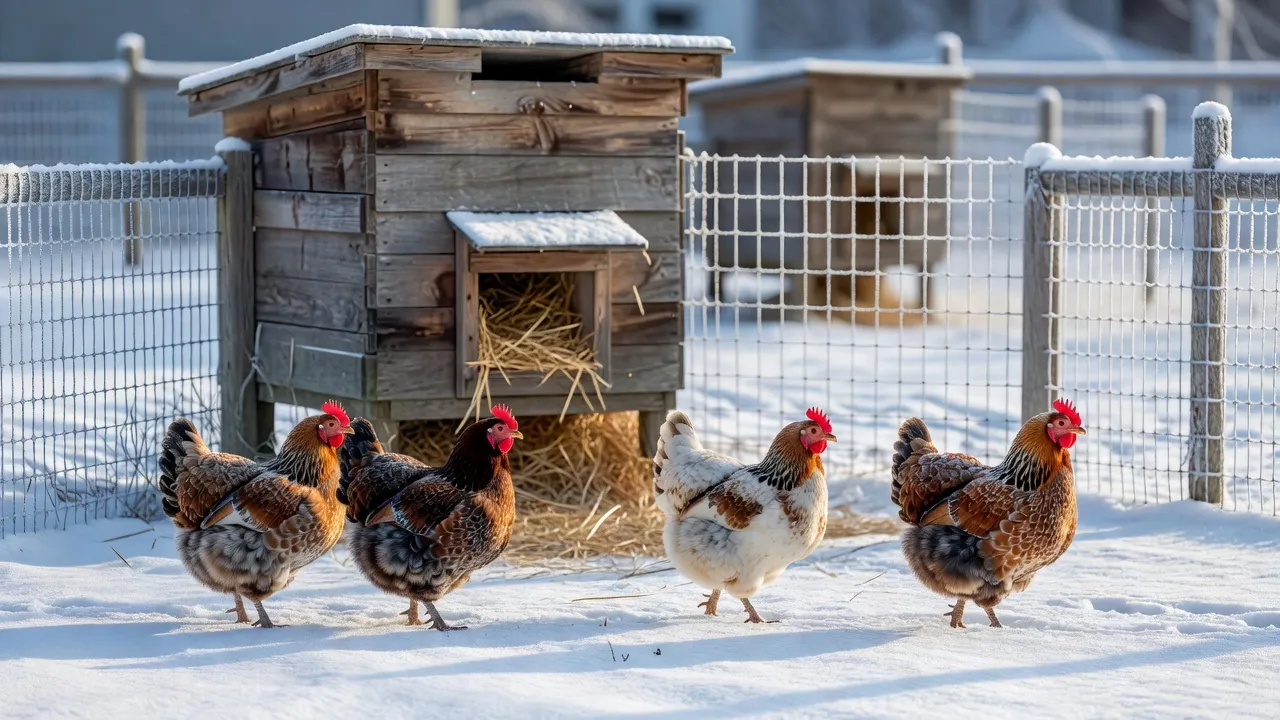
Yes, as long as they choose to go and have a dry coop to come back to. Chickens tend to avoid going outside in the snow, and a little hay laid in the run encourages them to come out, scratch around and forage (University of Minnesota Extension). Clear snow from the run to protect their feet when outdoors, and make sure every bird can roost off the floor at night (Ohioline). Clear ice as well as snow (K-State Research and Extension).
Feet carry the risk in snow. Frostbite hits combs, wattles and toes (eXtension). A flat-topped wooden roost, such as a 2x4, lets birds cover their feet with their feathers, while metal and plastic perches conduct cold to the feet and can cause frostbite (University of Maryland Extension). Soak frostbitten feet in slightly warm water to bring them back up slowly, and keep the bird out of the cold, because thawing and refreezing does more damage (eXtension).
Snow does not replace the waterer. Water that is frozen over is not available to the birds, and they cannot break through the ice (UMD). Keep liquid water out and check it often; the keep chicken water from freezing guide covers the options.
Should you put Vaseline on chicken combs?
It helps a little, and it does not replace a dry, ventilated coop. Apply petroleum jelly to combs and wattles to help insulate them and prevent frostbite damage, but it does not treat frostbite (University of Minnesota Extension). For mild freezing it helps, but coop management is the real key (eXtension).
Neither source gives a temperature at which to start or a schedule for reapplying, so this page does not either. If a comb or wattle already looks gray, black or brittle, call a veterinarian (UMN).
What to check in your own coop
- Look for condensation on windows or walls in the morning. It means you need more ventilation to keep the coop dry (eXtension). The ventilation guide covers vent area.
- Keep bedding dry and top it up. The extra layer also insulates (eXtension), and the insulation guide covers walls and ceilings.
- Check water at night and again in the morning. Both Oregon State and Ohioline raise frozen water. See heated chicken waterers.
- Decide on heat last. The heating guide compares two other extension services on heat and explains why a heat lamp is the riskiest choice.
This page is part of the winter coop guide. The comparison table uses three extension sources. University of Minnesota Extension adds the comfort range and the 35°F heat line, and Maryland and K-State add the snow and roost advice. Other extension services may give different numbers, and the heating guide compares two of them.
Questions people ask
How cold is too cold for chickens?
No single number is too cold for every flock. Comb tips can freeze at about 10°F (Oregon State Extension), and frostbite becomes a problem in single digits and below (eXtension). Most breeds tolerate even sub-freezing temperatures; wind and moisture cause the trouble (Ohioline).
What temperature can chickens tolerate in winter?
Acclimated chickens in a dry, draft-free coop tolerate even sub-freezing temperatures (Ohioline). Comb tips can freeze at about 10°F (Oregon State Extension), and University of Minnesota Extension advises supplemental heat once the coop falls below 35°F. Heavier breeds such as Plymouth Rock, Wyandotte and Orpington handle cold best (UMN).
At what temperature do chickens get frostbite?
Comb tips can freeze at about 10°F (Oregon State Extension). Frostbite strikes most often at night in a cold, poorly ventilated coop with damp bedding, and becomes a problem in single digits and below (eXtension). Humid air raises the risk more than dry air (Ohioline).
Do chickens need a heater when it is below freezing?
Usually not. Acclimated, cold-tolerant breeds in an insulated, dry coop with enough ventilation rarely need supplemental heat (Ohioline). Flocks do well at sub-zero temperatures with a deep litter system and an in-bucket water warmer and no external heat (eXtension). See heating a chicken coop for the extension split on heat.
Which chickens get frostbite most easily?
Roosters, because they usually have larger combs and wattles. Any hen with a large comb, such as a Leghorn, is vulnerable too, while pea and strawberry combs see much less frostbite (eXtension; Ohioline agrees on large combs and wattles).
What should I do if a chicken gets frostbite?
Warm the affected area slowly, with no hair dryer or heat lamp, and do not rub it. Leave blackened areas alone unless they become infected; healing takes four to six weeks (eXtension). Call a veterinarian if you see swelling, discharge or a bad odor.
Is it okay for chickens to walk in snow?
Yes, if they have a dry coop to return to. Clear snow and ice from the run to protect their feet (Ohioline; K-State Research and Extension), lay a little hay to coax them out (University of Minnesota Extension), and give them a flat wooden roost so they can cover their feet at night (University of Maryland Extension).
Should you put Vaseline on chicken combs in winter?
A little. Petroleum jelly on combs and wattles helps insulate them and prevent frostbite damage, but it does not treat frostbite (University of Minnesota Extension). It helps with mild freezing, and coop management is the real key (eXtension). Neither source gives a start temperature.
Sources
- University of Minnesota Extension: Caring for chickens in cold weather (reviewed 2026)
- Small and Backyard Poultry (eXtension): Frostbite in chickens, by Dr. Jacquie Jacob, University of Kentucky
- Oregon State University Extension Service: Keep the eggs coming with the right chicken care
- Ohioline (Ohio State University Extension): Winter and Your Backyard Chickens, ANR-66, 2018
- University of Maryland Extension: Winter Weather and Small Flocks (FS-1133, updated 2023)
- K-State Research and Extension, Douglas County: Winter care tips for laying hens (December 2023)

Written by Kyle
Kyle has kept backyard chickens on his own small farm for five years. He reads the extension research, the spec sheets and the owner complaints, then tells you what he would buy and what he would skip.