On this page
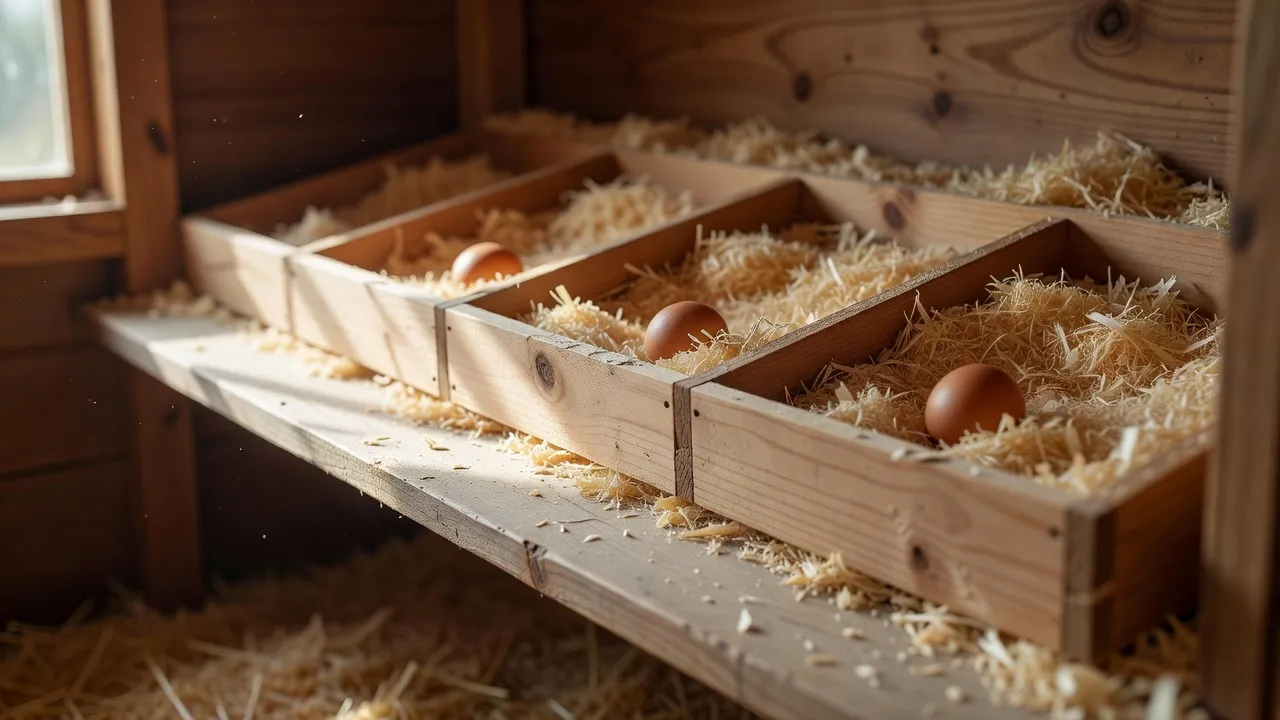
The nesting box dimensions for chickens come down to three numbers. Build each nest at least 12 inches wide and 12 inches deep (Penn State Extension), mount it at least 2 feet off the ground, and plan two nests for the first four hens plus one more for every four hens after that. This page shows how those numbers play out for bantams and big birds, how to count boxes for your flock, and a cut list for a three-box unit. It sits in the coop gear hub, next to Kyle’s nesting box picks if you would rather buy than build.
Short answer
12 × 12 inchesthe Penn State Extension minimum for one nest
Two nests cover the first four hens, and each four hens after that need one more. Put them at least 2 feet off the ground and at least 4 feet from the roosts, in a darker, quieter part of the coop.
Nesting box size by hen type
Build every nest at least 12 by 12 inches inside. That is Penn State’s floor for chickens, and the other guidance lands within a couple of inches of it.
| Hen type | Inside size to build | What the sources say |
|---|---|---|
| Standard laying hens | 12 × 12 inches, 12 inches tall | Penn State sets 12 × 12 as the minimum nest. My Pet Chicken says commercial boxes for standard breeds run roughly 11 or 12 inches cubed. |
| Bantams | 12 × 12 inches still works | My Pet Chicken says a box a little smaller is fine for bantams. Its smallest recommended box for standard breeds is 10 inches cubed. |
| Large breeds (Orpington, Cochin) | 12 to 14 inches | My Pet Chicken says 11 to 12 inches cubed is big enough even for Cochins and Orpingtons. Keepers in one Facebook group thread call 12 × 12 × 12 and 14 × 14 × 14 the common sizes. |
Height is the loosest number. Penn State gives none for the nest, My Pet Chicken calls for cubes, and another Facebook group thread lists boxes 18 to 20 inches tall. I would pick 12 inches for standard hens and 14 inches for heavy breeds. The cut list below uses 12.
Ready-made boxes list their outside size, and some seller pages leave the inside space blank. Check the inside against the 12 by 12 minimum before you pay. The nesting box picks flag every box where the inside size is missing.
Can you use a crate or bin as a nesting box?
Yes, if the inside meets the 12 by 12 inch minimum. Keepers in one Facebook group thread name grass catchers, old tree pots, cat carriers and milk crates as popular stand-ins, and another thread adds plastic bins and wooden boxes.
Measure the inside of any container before you mount it. A bin that comes up short on depth fails the same rule a built box does. Add a lip taller than 2 inches so it holds the bedding, and mount it at least 2 feet up like any other nest.
How many nesting boxes you need
Give hens two nests for the first four hens, then add one nest for every four additional hens. That is the Penn State Extension rule for small flocks.
| Hens in the flock | Nesting boxes |
|---|---|
| 4 | 2 |
| 8 | 3 |
| 12 | 4 |
| 16 | 5 |
| 20 | 6 |
For a flock between those numbers, round up. A keeper asking about 18 future hens on r/BackYardChickens gets six boxes from the rule: two for the first four hens, then 14 more hens, which is three groups of four plus two left over, so four more nests.
The eXtension poultry guidance is looser. It says one nest for every five hens is enough to prevent an increase in floor eggs. By that rule 10 hens need two boxes, and Penn State’s rule gives four. I would build to the higher count. An extra box costs a few dollars of plywood, and eXtension ties a short count to eggs on the floor.
If you are buying a whole coop, count the nests in the listing against this table before you check out. The chicken coop kits roundup is the place to compare kits.
Height and placement
Mount nests at least 2 feet off the ground and at least 4 feet away from the roosts. Penn State also says to place them in a darker, secluded area, and never across from bright sunny windows or near high-traffic areas.
My Pet Chicken adds a rule from the other direction: nests should sit lower than the lowest roosting pole, so the roost, not the box, is the high spot. Together the two rules fix the order of the build. Set the roost bars first, above 2 feet, then place the boxes lower than the lowest bar and 4 feet away.
In a small coop, 4 feet of separation from the roosts can be hard to find. Put the nests on the wall opposite the roosts and use the length of the coop. A landing ledge or short ramp in front of each box gives hens a way up to a nest that sits 2 feet off the floor.
Cut list for a 3-box build
A three-nest unit with 12 by 12 by 12 inch openings fits in one 4 by 8 foot sheet of plywood with room to spare. The parts below use 3/4 inch plywood and add up to about 14 square feet of the sheet’s 32.
The sizes are arithmetic from the 12 inch minimum, not a build log. Width is 3 openings × 12 inches plus four panel thicknesses (two ends and two dividers), so 36 + 3 = 39 inches.
| Part | Qty | Size in inches | Notes |
|---|---|---|---|
| Back | 1 | 39 × 13.5 | Full width, 12 inches of opening plus a panel thickness top and bottom |
| Top | 1 | 39 × 12 | Sits flush with the top edge of the back |
| Bottom | 1 | 39 × 12 | Sits flush with the bottom edge of the back |
| Ends and dividers | 4 | 12 × 12 | Fit between top and bottom, flush with their front edges |
| Front lips | 3 | 12 long | Cut taller than 2 inches so they hold in the bedding |
| Landing ledge | 1 | 39 long | Optional board under the front edge |
The finished unit measures 39 inches wide, 13.5 inches tall and 12.75 inches deep. With thinner plywood, use the same formula: the width is 36 inches plus four panel thicknesses, and the back is 12 inches plus two thicknesses tall.
Mark the panel positions on the back before you glue anything. Measured from the left edge of the back, with 3/4 inch plywood, each panel sits here:
| Panel | Left face at (in) | Right face at (in) |
|---|---|---|
| Left end | 0 | 0.75 |
| Divider 1 | 12.75 | 13.5 |
| Divider 2 | 25.5 | 26.25 |
| Right end | 38.25 | 39 |
Each opening runs 12 inches between faces: 0.75 to 12.75, 13.5 to 25.5 and 26.25 to 38.25.
Glue every joint, drill a pilot hole for every screw and countersink the heads. Plywood splits when a screw runs close to an edge without a pilot hole. That covers a common complaint on a popular nest box build video, where viewers report split wood and ask for screw sizes and drill bits.
Fit the boxes with the bedding and routine that go with the size. eXtension says to keep 2 inches of clean, dry nesting material in the nests at all times as egg padding. Penn State says to collect eggs two times daily. A lip taller than 2 inches keeps that bedding in.
Checklist before you drill
Nest box numbers to hit
- Count: 2 nests for the first four hens, then 1 more per four hens (Penn State).
- Inside size: at least 12 by 12 inches.
- Height: at least 2 feet off the ground, at least 4 feet from the roosts, lower than the lowest roost.
- Location: darker and secluded, away from bright windows and busy areas.
- Bedding: 2 inches of clean, dry nesting material, held in by a lip taller than 2 inches.
- Routine: collect eggs twice a day.
Questions people ask
What size should a chicken nesting box be?
At least 12 inches wide and 12 inches deep inside, which is the Penn State Extension minimum for a chicken nest. Build to 12 inches tall for standard hens. Heavy breeds like Orpingtons and Cochins fit a 12 inch box, and some keepers go to 14 inches for extra room.
How high off the ground should a nesting box be?
At least 2 feet off the ground and at least 4 feet away from the roosts, per Penn State Extension. Keep the roost bars higher than the nests so hens do not sleep in the boxes.
How many nesting boxes per chicken?
Two nests for the first four hens, then one more nest for every four extra hens (Penn State Extension). Six hens need 3 nests and ten hens need 4. Round up for flocks between the sizes in the table.
Do bantams need smaller nesting boxes?
They can use a smaller box, but a 12 by 12 inch nest still meets the Penn State minimum and works for bantams. My Pet Chicken says a box a little smaller is fine for bantams, and gives 10 inches cubed as the smallest box for standard breeds.
Sources

Written by Kyle
Kyle has kept backyard chickens on his own small farm for five years. He reads the extension research, the spec sheets and the owner complaints, then tells you what he would buy and what he would skip.