On this page
- Quick problem finder
- Failure 1: ice and freeze-thaw
- Failure 2: dead batteries and solar in shade
- Failure 3: WiFi and app doors that lose connection
- Failure 4: light sensor and timer mistakes
- Failure 5: a door that closes on a hen or jams
- Hens locked out at dusk and shut in on hot mornings
- How to get an alert when a door fails
- Brand troubleshooting pages
When an automatic chicken door is not working, the cause falls into one of five groups: ice or debris in the track, dead batteries or weak solar, a lost WiFi connection, a light sensor or timer set wrong, or a jam that trips the obstacle sensor. Each has a fix below. The failure that matters more is the one you don’t see. A door that stays open overnight lets a predator in, and a door that stays shut on a hot morning can cook a flock. One habit protects your hens in every case: confirm the door closed at dusk, by eye or by alert.
Short answer
5 failures, 1 habitice, power, WiFi, timing, jams
The five failures are ice or debris in the track, dead batteries or solar in shade, a lost WiFi connection, a light sensor or timer set wrong, and a door that closes on a hen or jams. The habit is a look at the door at dusk, or a sensor or camera that alerts you when it did not close.
Quick problem finder
Match what you see to the likely cause and check that first. The table condenses the fault lists in Cooptender’s guide and Omlet’s fault guide.
| What you see | Likely cause | Check first |
|---|---|---|
| Door will not move, no motor sound | Power switch off, loose cord, dead outlet or battery | Switch, cord and battery |
| Motor runs but the door stays put | Debris, or dry or thickened lubricant on the drive; track out of line | Clear the track, clean the drive |
| Door opens or closes at the wrong time | Light threshold, a nearby light, a wrong clock entry | Clock, 24-hour entry, sensitivity, or switch to timer mode |
| Door stops, reopens or shows an error | Something in the doorway, or a jammed or corroded sensor | Clear the doorway, then clean and recalibrate |
| Door sticks in winter | Ice in the track, cold-weakened batteries | Clear the ice, warm the batteries or move to mains |
| App shows offline, schedule missed | Lost WiFi, or a door that depends on it | Router range and band, and whether the schedule lives on the door |
Failure 1: ice and freeze-thaw
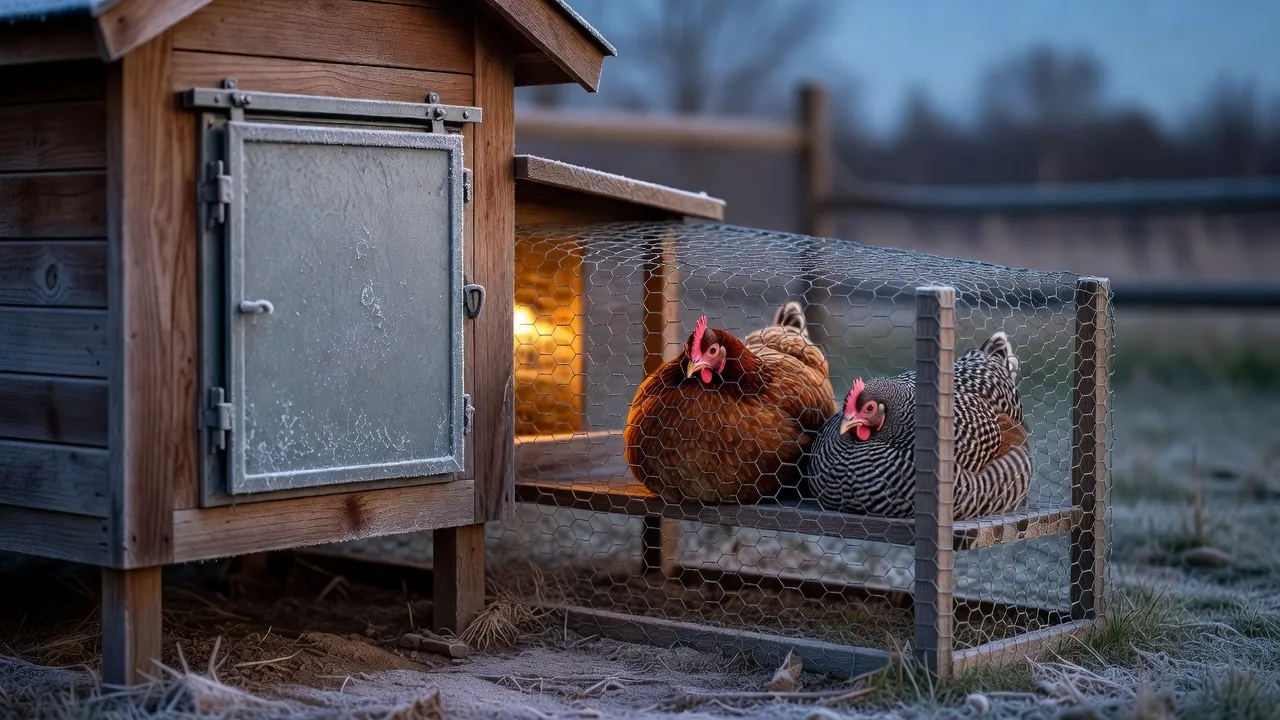
Ice jams the track and cold weakens batteries, so a door that works in October can stick in January. Cooptender says ice forms around the door edges and track and blocks movement, and its fix is to remove the ice by hand and keep the coop ventilated to cut moisture. The same guide says lubricant thickens in cold, which produces the “motor runs but door doesn’t move” symptom, and it points owners to low-temperature lithium grease.
Batteries sag in the same weather. Cooptender says battery capacity drops significantly below about 20°F and suggests mains power for the coldest months. Omlet gives alkaline batteries an operating range of 0°F to 131°F (-18°C to 55°C), says its Autodoor is built to work down to -4°F (-20°C), and tells owners to warm the batteries now and then during a long cold spell. Two makers, two numbers. Read the manual for your own door.
Owners see the freeze in the wild. A commenter in an r/homeautomation thread says their Run-Chicken door sometimes freezes open or closed. One door seller’s list of cheap-door failures flags locks that cannot be released by hand when they freeze, which is a seller’s claim but a fair question to ask any maker.
My advice is simple. Mount the door under an overhang, or build a small roof over the track, so freezing rain and drifting snow never reach it. Fix a wet coop before you blame the door, since moisture is what turns a damp track into ice. The winter ventilation guide covers that. Whichever door style you pick, a track you can see and reach is a track you can clear. The best automatic doors roundup compares door styles.
Failure 2: dead batteries and solar in shade
A dead battery leaves the door wherever it stopped, and a solar panel in shade runs the battery down all winter. Cooptender names three power culprits for battery and solar doors: a battery older than about 3 to 5 years, weak sunlight, and wiring faults such as reversed solar leads or a blown fuse. It says even partial shade cuts solar output a lot, that short winter days give minimal charging, and that panels need to stay clear of trees, overhangs and snow.
Battery life is a standing support topic at the big makers. ChickenGuard’s troubleshooting collection has articles on short battery life and short battery life in winter, and Omlet answers the cold-weather question on its help center. Omlet says its battery Autodoor runs on 4 AA batteries for up to 6 months on its product page. One seller’s list also claims some cheap doors give no low-battery warning and lose their settings when you swap batteries.
Pick a door that warns you before the battery dies, and change batteries on a calendar date instead of waiting for the warning. If you want solar anyway, read the solar door guide first, because winter shade is where solar doors fall short.
Failure 3: WiFi and app doors that lose connection
A door that needs WiFi to close can miss a close when the connection drops. One keeper wrote in a backyard poultry Facebook group that they lost their whole flock after the door did not shut at 6:38 pm because it lost its internet connection. The post does not say which brand.
The fix starts before you buy. Ask whether the schedule lives on the door itself and whether it closes with WiFi off. Omlet’s support center says all the settings are saved in the control panel, so the door keeps working as programmed during an outage and the app returns once the connection does. That is the design I want: WiFi adds alerts and remote control, and it never decides whether the door closes. The Omlet review goes through that door in detail.
If you already own a WiFi door, fix the signal. Cooptender lists the usual problems: wrong credentials (they are case-sensitive), a 5 GHz network on a door that needs 2.4 GHz, router filtering, metal near the module, and distance. Omlet says its door works best within 30 feet of the router, and its support page says within 65 feet of a WiFi source. Plan for the shorter number, and add a range extender if the coop sits far from the house.
Failure 4: light sensor and timer mistakes
Wrong-time doors come down to three settings: the light threshold, the clock and the schedule. Cooptender says light sensors misfire when the threshold does not fit your coop, when a nearby artificial light confuses the sensor, or when the seasons shift daylight. Its fix is to adjust sensitivity and watch the door for several days, or to switch to timer mode. For timers, it says to check the clock and enter times in 24-hour format.
Seasons matter most with a fixed timer. A close time that suits December locks late hens out in June, and one that suits June leaves the door open for hours after dark in December. A porch light, yard light or street light shining on a light sensor can hold the door open at night. After the clocks change, check the door’s clock; the guides above tell you to verify the time, and a mistake of one hour is enough to cause trouble.
Software bugs add a fourth cause. Omlet’s public firmware changelog lists a fix for mains-powered doors in time mode that opened or closed at the wrong time after a power cut. Keep the firmware current on any app door.
Failure 5: a door that closes on a hen or jams
Obstacle sensors stop the door from crushing a hen, and when they trip, the door retries and then stays open. That is the safe failure for the hen and the dangerous one for the flock overnight. Omlet’s Crush Detected explainer says its sensors find an obstruction, most often a chicken lingering in the doorway. The door nudges the obstruction, reopens, tries to close up to five more times, and then stays open and shows an error. Smart doors also send an app notification. Without a notification, a door that stays open and shows an error on a panel nobody is watching is an open door.
Jams come from the same places on every brand. Cooptender lists feathers, bedding, debris and ice in the track. A commenter on the YouTube video My Automatic Chicken Coop Door FAILED After 1 Year says that after months of disuse, removing chunks of dirt let the door close again and start its own calibration. A door seller also claims that geared mechanisms on cheap doors can injure a bird caught under the door and that straw, manure, dust and mud jam them. Treat that as a reason to ask about obstacle sensing, not as a measured failure rate.
Owners report obstruction errors in the wild. A keeper in a Facebook group says an Omlet door bought in January ran fine and later got stuck opening with a crush-detected message. Omlet’s guide also tells owners to check that the roosting rack sits in its correct position.
Hens locked out at dusk and shut in on hot mornings
A failed door hurts in two directions: it leaves hens outside or the coop open at night, and it keeps hens shut in when the day heats up. Both outcomes show up in owner threads.
Locked out or left open
A door that closes early, or never closes, puts the flock in the open. The r/chickens thread “Automatic door open failure” and a Facebook post titled Auto chicken coop door failure leaves chickens roosting outside describe the problem. One keeper in another Facebook group lets the door open by timer in the morning but won’t close it at night until they have checked that every bird is in. A door cannot count hens, and that check is the one job a timer cannot do. Treat the door as one layer of defense and read the predator-proof coop guide for the rest.
Shut in during heat
A door that stays shut on a hot morning turns the coop into a hazard. In the r/BackYardChickens thread Auto door failed, 3 chickens died, the top reply tells the poster: “You have two problems. Auto door failure and your coop is getting too hot.” A commenter in the r/homeautomation thread above says a friend lost their chickens in Florida heat when a door failed to open one morning.
Penn State Extension says heat stress in poultry begins above 80°F and that survival becomes a concern above 100°F, and it stresses clean, cool water and ventilation. So the fix goes beyond the door. Give the coop vent area that stays open day and night, covered with hardware cloth, and keep water inside the coop. The ventilation guide explains vent sizing, which protects hens in summer too. If your mornings run hot, a second exit that does not depend on the automatic door gives hens a way out when the door sticks shut.
Hot morning, shut door
Penn State Extension puts the start of heat stress above 80°F and lists survival as a concern above 100°F. On a hot forecast, open the door by hand before you leave and confirm the vents are open.
How to get an alert when a door fails
A door contact sensor, a camera or a smart plug turns a silent failure into a phone alert, and the contact sensor does the most for the least effort. Pick one, then set the alert to fire if the door still reads open some time after its scheduled close.
- A magnetic sensor on the door reports open or closed to a home hub. A commenter in the r/homeautomation thread suggests a cheap Zigbee door sensor, and the same subreddit has a Show and Tell post on a chicken coop door sensor. Check that the hub and the sensor battery stay powered, because a dead sensor is its own silent failure. Prices vary by hub and brand, so check the current price on the product you pick.
- A WiFi camera with night view aimed at the door shows the door and the hens in one frame. It needs power and a WiFi signal at the coop, and it doubles as a heat check on summer mornings.
- On a plug-in door, a smart plug on the power adapter tells you when mains power drops. It does not confirm that the door closed, so use it with a sensor or camera, not instead of one.
- A poster in the Auto door failed thread says they have two doors and hope they fail at different times. Pair doors of different brands or power types, so one cause such as a power cut, a WiFi outage or a frozen track does not take both.
Brand troubleshooting pages
Start with the maker’s own guide for your model, because the fix list differs by door.
- Omlet: the Door Fault Troubleshooting guide runs through eleven checks: firmware, inspection, cleaning, roosting-rack position, recalibration, warping, motor, gear stay, gear rack, control-panel connectors and wiring. Its last step is replacing parts. The Omlet review summarizes these and the owner reports.
- ChickenGuard: the help center collection lists articles on batteries, light sensor help, wrong open and close times, a stopped motor and door obstruction errors.
- Cooptender: the troubleshooting guide splits faults into won’t open or close, wrong time, WiFi, motor runs but door doesn’t move, and power.
- Run-Chicken and Chickcozy: use the manual that came with the door and the maker’s support team. Photograph the fault before you take anything apart.
Door failures, brands and what they cost all live in the automatic chicken coop doors hub.
Questions people ask
Why won't my automatic chicken door close?
Check in this order: power (switch, cord, battery), debris or ice in the track, something in the doorway that trips the obstacle sensor, then the light sensor or timer settings. Cooptender's guide and Omlet's fault guide walk through those checks for their own doors.
Why does my coop door open at the wrong time?
The usual causes are a light sensor threshold that does not fit your coop, a yard or street light near the sensor, the season shifting dusk, or a wrong clock entry. Cooptender says to adjust sensitivity and watch it for several days, switch to timer mode, and enter times in 24-hour format. Check the door's clock whenever the clocks change.
Can an auto door kill a chicken?
Yes, in three ways. A door that stays open or leaves hens outside exposes the flock to predators, a door that stays shut can trap hens in a hot coop, and a door can close on a bird. Obstacle sensors exist for the last one, and a sensor or camera alert covers the first two.
How do I know if my coop door closed?
Look at it at dusk with the hens inside, or add a contact sensor or camera that sends a phone alert if the door is still open after its scheduled close time. A schedule tells you what the door should do, not what it did.
Should I still close the door by hand?
Until you have an alert, yes. A timer cannot count hens, so a quick dusk check is the backup. Once an alert is in place, keep the hand close as the plan for storm nights and for any evening the alert goes quiet.
Sources
- Omlet help center: Door Fault Troubleshooting
- Omlet help center: What does the Crush Detected message mean?
- Omlet help center: Does cold weather affect the batteries?
- Omlet Smart Autodoor support center (connection loss, power)
- Cooptender: Automatic chicken door troubleshooting guide
- ChickenGuard help center: Door opener troubleshooting advice
- Penn State Extension: Hot Weather Management of Poultry
- Safe Coop (a door seller): 21 reasons to avoid cheap automatic chicken doors
- r/BackYardChickens: Auto door failed, 3 chickens died (owner report)
- r/homeautomation thread on a chicken door sensor (owner reports)

Written by Kyle
Kyle has kept backyard chickens on his own small farm for five years. He reads the extension research, the spec sheets and the owner complaints, then tells you what he would buy and what he would skip.