On this page
The best automatic chicken coop door for most keepers is the Run-Chicken T50, at $129.90 to $139.90. It is the cheapest door on this page, and its product page lists the two features I care about most: a motor lock and an anti-pinch mode that stops and reverses when a hen is in the way. Cold winters push me toward the ChickenGuard Pro, big breeds toward the Run-Chicken Giant, and a sunny coop toward the Chickcozy Solar. Omlet makes the pick for keepers who want phone alerts.
No door is failure-proof. Owners of Run-Chicken, ChickenGuard and Omlet doors all report doors that froze, jammed or quit, and a dead door at dusk can cost a flock. So this guide also covers how doors fail and the one habit that covers all of it: look at the coop at dusk. For the full list of failures, read why automatic coop doors fail. For the wider picture on choosing a door for a chicken coop, start at the automatic coop doors hub.
Quick picks
Prices were checked on each maker’s own site on 2026-10-09. “Not stated” means the product page I read does not say, so ask the seller before you buy. Lock and sensor entries are the makers’ own claims.
| Door | Best for | Price (checked 2026-10-09) | Power | Lock | Obstacle sensing | Opening | App |
|---|---|---|---|---|---|---|---|
| Run-Chicken T50 | Best overall | $129.90 to $139.90 | 2 AA | Motor lock | Anti-pinch, reverses | 8 × 10 in | Yes, link type not stated |
| ChickenGuard Pro | Cold climates, DIY doors | $139.98 | 4 AA or 9 to 12 V DC | Not stated on Pro page | Not stated | Lifts doors up to 2 kg | None stated |
| Run-Chicken Giant | Large breeds | $289.90 | USB-C rechargeable | Motor lock | Not stated | 14.2 × 19.7 in | Yes, link type not stated |
| Chickcozy Solar | Best solar | $159.00 | Solar panel plus 3200 mAh battery | Self-locks | Touch sensor, reopens | 8.25 × 10.4 in | None stated |
| Omlet Smart Autodoor | Phone alerts | $229 | 4 AA or plug-in | High-torque hold | Blockage sensor | Varies by model | Wi-Fi app |
How I chose these doors
I rank doors on the failures that cost hens, not on feature lists. Every pick comes from the maker’s product page and manual, current prices, and owner reports from Reddit, Facebook groups and YouTube comments. I link each owner report so you can read it yourself. These are my reads of specs and reports, not bench results. A brochure is not a verdict.
Five checks decide the ranking:
- The motor must hold the closed door against a pull from outside.
- A sensor must stop and reverse the door when a hen is in the way; a door that closes on her can kill her.
- Choose mains power, batteries you replace on a calendar, or a solar panel with winter sun.
- A schedule that survives bad Wi-Fi. I prefer doors you can set at the control panel or run from a light sensor.
- An opening your biggest hen fits through, and a temperature rating that fits your winters.
I weigh those above price. A secure door costs about $130 to $230, which is a small slice of a predator-proof setup. One r/BackYardChickens keeper put a fully predator-proofed coop and run at about $1,000.
The five doors
Run-Chicken T50: best overall
The T50 lists a motor-locking system that stops predators lifting the door and an anti-pinch mode that stops and reverses on resistance, then tries again. That covers the two failure modes I worry about most, for $129.90 to $139.90 direct. Walmart and Amazon list it at $129.99. The sunrise and sunset mode opens 15 minutes after sunrise and closes 15 minutes after sunset, and you can shift both by up to 60 minutes. Two AA batteries run it, and the maker says they last about a year.
The weak points are real. The 8 × 10 in opening is tight for large breeds, the page does not say how the app connects, and Run-Chicken lists lifetime customer support instead of a warranty term.
Run-Chicken T50
most coops with standard-size hens and a tight budget
- Power
- 2 AA batteries, about 1 year per set (maker)
- Opening
- 8 × 10 in; door 9.5 × 14 in; full open height 24 in
- Modes
- Sunrise and sunset, timer, manual app control
- Lock
- Motor-locking system
- Obstacle sensing
- Anti-pinch, stops and reverses
- Warranty
- Lifetime customer support, no term stated
- Motor lock and anti-pinch both listed
- Lowest price of the doors compared here
- Offsets adjustable up to 60 minutes
- Light at 1.8 lb
- 8 × 10 in opening is small for large breeds
- App connection type not stated
- No warranty term on the product page
What owners report
One keeper in r/homeautomation says their Run-Chicken door sometimes freezes open or closed. A commenter on a Chicken Fans door roundup says a Wi-Fi Run-Chicken door worked about three months, crashed after an update, and that a predator killed six of their hens that night.
ChickenGuard Pro: best for cold climates and DIY doors
ChickenGuard lists the Pro at $139.98 and its range at $139.98 to $189.98. The Pro is the motor and controller. It lifts doors up to 2 kg, so it suits a door you built yourself. It runs on four AA batteries or 9 to 12 V DC mains power, and it offers four modes: light sensor, timer, manual and Dualsafe. Dualsafe sets an open and close time, or opens at daybreak and closes at dusk, whichever comes first.
Mains power is why I put it first for cold winters, because it takes the battery question off the table. A power cut still stops a plug-in door, so ask ChickenGuard whether batteries stay in as a backup. ChickenGuard lists a 3-year warranty and a range of -4°F to 140°F. The Pro page states no lock, no obstacle sensing and no door size, and it showed the Pro out of stock when I checked prices. The homepage lists the Pro Door Kit at $169.98 and the Pro Kit Solar at $189.98 as available. The page mentions no app or Wi-Fi, which I count as one less thing that can drop out.
ChickenGuard Pro
cold winters, DIY doors, and keepers who want no Wi-Fi dependence
- Power
- 4 AA batteries or 9 to 12 V DC mains
- Modes
- Light sensor, timer, manual, Dualsafe
- Lifts
- Doors up to 2 kg
- Rated range
- -4°F to 140°F
- Warranty
- 3 years
- Lock and obstacle sensing
- Not stated on the Pro page
- Mains or battery power
- Longest warranty of the doors compared
- Four modes, none needing an app
- Fits a door you build yourself
- Lock, obstacle sensing and door size not stated on the Pro page
- Listed as out of stock when prices were checked
- Door may not be included, so check the box contents
What owners report
A commenter on a Chicken Fans door roundup says their ChickenGuard lasted just over a year and then quit, even though it sat inside the coop out of the weather.
Run-Chicken Giant: best for large breeds
The Giant is Run-Chicken’s XXL door, sold for large breeds, turkeys, geese, small goats and sheep. The door measures 15.7 × 23.6 in, the opening is 14.2 × 19.7 in, and it weighs 4.7 lb. Rechargeable batteries come in the box, charge over USB-C, and last about a year per charge, per the maker. It accepts the Run-Chicken solar panel, sold separately. Price: $289.90, about $150 more than the T50.
It claims the same motor lock and the same sunrise, timer and app modes. The page does not mention anti-pinch. I found no owner reports for the Giant, so treat it as unproven. Buy it only if your biggest hen cannot walk through a smaller opening upright.
Run-Chicken Giant
large breeds, turkeys and geese
- Opening
- 14.2 × 19.7 in; door 15.7 × 23.6 in; full open height 43.7 in
- Power
- Included rechargeable batteries, USB-C charging, about 1 year per charge (maker)
- Weight
- 4.7 lb
- Lock
- Motor-locking system
- Modes
- Sunrise and sunset, timer, manual app control
- Solar
- Run-Chicken solar panel fits, sold separately
- Largest opening of the doors compared
- Motor lock listed
- Takes a solar panel if you add one
- About $150 more than the T50
- Anti-pinch not stated
- No owner reports found
Chickcozy Solar: best solar
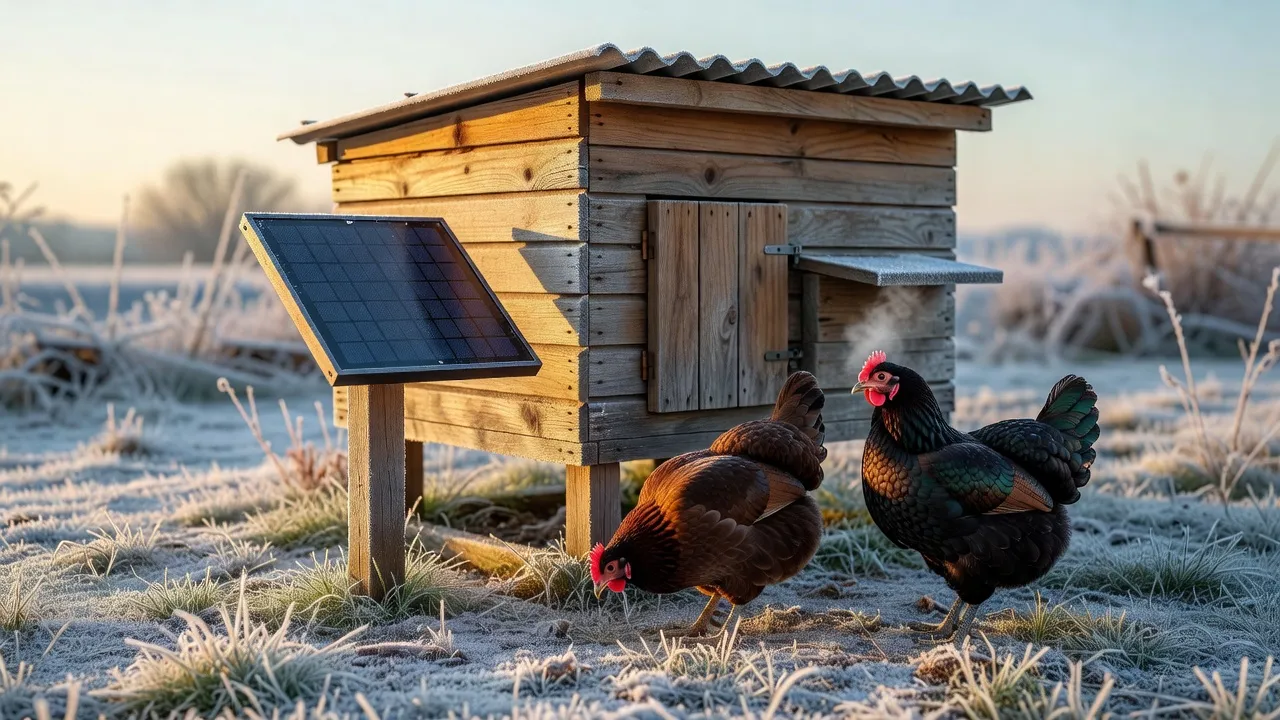
The Chickcozy Solar costs $159.00 (regular price $169). The door opens from the center to the sides, self-locks once closed, and has a touch sensor on the right door panel. The sensor stops the door and reopens it when it meets resistance. A built-in 3200 mAh rechargeable battery sits behind the solar panel, the warranty runs 2 years, and the homepage lists -20°F to 140°F.
The gaps matter. Chickcozy publishes neither the panel wattage nor how long a full charge lasts. I found no owner reports tied to this exact model. Any solar door can fail in winter shade, which the solar door guide covers in detail.
Chickcozy Solar Automatic Chicken Coop Door
a coop with a sunny spot for the panel all winter
- Power
- Solar panel plus built-in 3200 mAh rechargeable battery
- Opening
- 8.25 × 10.4 in; opens from the center to the sides
- Modes
- Timer, light, manual
- Lock
- Self-locks once closed
- Obstacle sensing
- Touch sensor on the right door panel, stops and reopens
- Rated range
- -20°F to 140°F
- Warranty
- 2 years
- Self-lock and touch sensor both listed
- No batteries to swap
- Widest stated temperature range of the doors compared
- Sliding-style opening has no panel to lift
- Panel wattage and runtime without sun not published
- Winter shade can starve any solar door
- Opening is smaller than the Giant's
Omlet Smart Autodoor: best for phone alerts
The Smart Autodoor adds Wi-Fi, real-time notifications and control from the Omlet app, and it works with Alexa and Google Home. You can set open and close times at the control panel, use the light sensor, or use the app, and a compatible coop light switches on five minutes before the door closes. Omlet says all the settings are saved in the control panel. It runs on four AA batteries or plugs in, and the Eglu Go version lists operation down to -4°F. Omlet describes a high-torque motor that stops anything opening a closed door, plus a sensor that detects blockages.
The Smart Autodoor lists at $229 on omlet.us (checked 2026-10-09, valid through 2026-10-23), and the non-smart version is $199. Owners report the most friction here, as the card shows. The Omlet Autodoor review goes through the price, the fix steps and the alternatives.
Omlet Smart Autodoor
keepers who want notifications, app control and voice assistants
- Power
- 4 AA batteries (not supplied) or plug-in with an optional cable
- Modes
- Control-panel times, light sensor, app
- Connectivity
- Wi-Fi, Omlet app, Alexa, Google Home
- Lock
- High-torque motor holds the closed door (maker)
- Obstacle sensing
- Sensor that detects blockages
- Rated range
- Down to -4°F (Eglu Go version)
- Phone notifications when the door moves
- Settings stored in the control panel
- Coop light switches on before closing
- Wi-Fi adds a point of failure
- Owner reports of stuck and mistimed doors
What owners report
A keeper in a Facebook group says their Omlet door, bought in January, started getting stuck opening with a crush-detected fault. A keeper on r/BackYardChickens asks why a Wi-Fi door opens outside its scheduled window. A commenter on a failed-door video says their Omlet door broke after a few years and the replacement had the same fault out of the box.
Vertical vs sliding doors: which ones raccoons lift
A raccoon can only lift a vertical door if nothing holds it down, so the lock matters more than the direction of travel. Chickcozy opens from the center to the sides, so there is no panel to lift. The ChickenGuard opener lifts a door. The Run-Chicken and Omlet pages I read do not state a direction.
Every maker here claims the motor holds the closed door. Run-Chicken says its motor lock stops predators lifting the door, Chickcozy says the door self-locks once closed, and Omlet says a high-torque motor means nothing can open it. Those are claims, and I found no independent raccoon test of any of them. eXtension says raccoons enter poultry houses and take several birds in one night, so the stakes are high.
My rule has three parts. Buy a door whose maker states a lock. Pick one that closes into a frame, not against a loose edge. Then put it on a coop that is already predator-proof, because the door is one layer, not the whole wall.
Battery, solar or plug-in
Battery is the safe default, plug-in suits a coop near an outlet, and solar suits only a coop with a panel spot in full winter sun. Here is how the five doors split:
- Battery: the Run-Chicken T50 runs on 2 AA batteries and the maker says they last about a year. The Omlet and the ChickenGuard Pro take 4 AA.
- Plug-in: the ChickenGuard Pro accepts 9 to 12 V DC mains, and Omlet lists a plug-in option that it says gives increased app responsiveness.
- Solar: the Chickcozy has a built-in solar panel and battery. The Run-Chicken Giant charges over USB-C and accepts Run-Chicken’s solar panel, sold separately.
Batteries fail on a schedule you control, so change them on a calendar date. Solar fails when the sun does. Plug-in fails in a power cut. The solar guide shows how to site a panel so winter does not starve it.
What owners say goes wrong
Owners report three failure patterns: doors freezing shut or open, Wi-Fi doors that do not close when the connection drops, and doors closing with hens still outside. I cite threads here, not percentages, because I have no survey data yet.
- The r/homeautomation keeper above says their Run-Chicken door sometimes freezes open or closed.
- A keeper in a Facebook poultry group says a Wi-Fi door never closed after the home internet dropped.
- In an r/BackYardChickens thread about three hens that died after a door failure, the top reply says the keeper had two problems: the door failing and a coop that gets too hot. A door that stays shut on a hot morning is a ventilation problem too.
An Australian seller of premium doors also lists problems it sees in cheap ones: a door that fails to close, a door a fox can break through, poor longevity, and a lock that sticks shut. It sells doors, so read that list as a seller’s view. I would still skip a door that states no lock.
Look at the coop at dusk
An automatic door replaces the chore, not the check. Count the hens, then watch the door close. Add a phone alert from a door sensor if you cannot be home at dusk.
Which door fits your coop
| Your situation | Pick | Why |
|---|---|---|
| Most coops, tight budget | Run-Chicken T50 | Lowest price, motor lock and anti-pinch both listed |
| Cold winters with an outlet nearby | ChickenGuard Pro | Mains power, -4°F to 140°F, 3-year warranty |
| A door you built yourself | ChickenGuard Pro | The opener lifts doors up to 2 kg |
| Large breeds | Run-Chicken Giant | 14.2 × 19.7 in opening |
| A clear southern spot for a panel | Chickcozy Solar | Built-in solar and battery, self-lock, touch sensor |
| Phone alerts and voice control | Omlet Smart Autodoor | Wi-Fi app and notifications |
| A deeply shaded coop | A battery or plug-in door | Solar needs light in winter |
Questions people ask
Are automatic chicken doors safe for chickens?
They are safe when the door locks, senses a hen in the way and you still look at the coop at dusk. Run-Chicken lists an anti-pinch mode that stops and reverses on resistance, and Chickcozy lists a touch sensor that stops the door and reopens it. Owners also report doors that closed on the wrong side of a hen or never closed at all, so treat the door as a helper, not a guarantee. The failure guide covers each case.
Do automatic coop doors freeze in winter?
Some do. One keeper in r/homeautomation says their Run-Chicken door sometimes freezes open or closed. Makers list temperature ratings, such as -4°F to 140°F for the ChickenGuard Pro and -20°F to 140°F for the Chickcozy solar door, but a rating says nothing about ice in the track. Keep the track clean, put a roof over the door, and check it after freezing rain.
Can a raccoon open an automatic chicken door?
The makers say their motors hold the closed door, and I found no independent raccoon test of any of them. eXtension says raccoons enter poultry houses and take several birds in one night, and tells keepers to close and lock all doors at night. Pick a door whose maker states a lock, then put it on a coop that is already predator-proof.
Solar or battery: which is better?
Battery is the safer default. Solar works when the panel sits in full sun through December and January, which many coops cannot manage. If you have a clear southern spot for a panel, read the solar door guide first.
What size door opening do large breeds need?
Measure your biggest hen's standing height and body width, then compare the opening, not the door. The Run-Chicken T50 opening is 8 × 10 in, the Chickcozy opening is 8.25 × 10.4 in, and the Run-Chicken Giant opens 14.2 × 19.7 in for large breeds.
What if the battery dies or Wi-Fi drops, and do I still check the coop at night?
A dead battery stops the door wherever it sits. One keeper in a Facebook poultry group says they lost their whole flock when a Wi-Fi door lost its connection and did not close. Choose a door you can program at the control panel, change batteries on a calendar, and learn the manual override. Then check the coop yourself: eXtension says to have the flock roost in a secured location at night with all doors closed and locked, and a 30-second headcount at dusk beats any sensor.
Sources
- ChickenGuard Pro product page
- ChickenGuard homepage (range and prices)
- Run-Chicken T50 product page
- Run-Chicken Giant product page
- Chickcozy Solar Automatic Chicken Coop Door product page
- Chickcozy spec page
- Omlet US: Smart Automatic Chicken Coop Door (product page and prices)
- Omlet Smart Autodoor for Eglu Go coops
- Omlet Smart Autodoor control panel
- eXtension: Predator management for small and backyard poultry flocks
- Owner report: r/BackYardChickens, Auto door failed, 3 chickens died
- Owner report: r/homeautomation, Making solar powered battery chicken coop door smart

Written by Kyle
Kyle has kept backyard chickens on his own small farm for five years. He reads the extension research, the spec sheets and the owner complaints, then tells you what he would buy and what he would skip.