
On this page
A chicken roost bar should sit about 2 feet off the floor, give each hen 8 to 10 inches of length and be made of square wood with the top edges rounded. Those figures come from Penn State Extension, Oregon State Extension and the University of Minnesota. This page covers height, spacing, wood and the dropping board, or poop board, that catches what falls underneath. It sits in Kyle’s coop gear guides.
Short answer
2 feet up, 8 to 10 inches per henfrom Penn State, Oregon State and Minnesota Extension
Use 2 by 2 or similar square lumber with rounded edges. Space parallel bars 10 to 12 inches apart, keep them higher than the nest boxes and make them removable so you can clean underneath.
The short version
- Penn State and Oregon State both set roosts about 24 inches off the floor. Minnesota’s minimum is 12 inches.
- Per-hen length runs from 5 to 12 inches across sources. Plan 8 to 10 inches for standard hens.
- Square wood with rounded top edges beats metal, plastic and small round dowels in the extension guidance.
- Bars go 10 to 12 inches apart.
- A dropping board under the roost keeps manure out of the bedding, per University of Kentucky Extension.
- Maryland and Oregon State disagree on nest height. Hens sleep at the highest point, so keep the roost highest.
How high should a chicken roost bar be?
About 2 feet for standard hens. Penn State places roosts 24 inches above the floor, and Oregon State’s coop design bulletin sets poles 2 feet off the floor. Go no lower than 12 inches above the floor (University of Minnesota). Silkies need a roost only 1 foot up (Oregon State).
Higher is not always better. A lowest perch about 3 feet off the floor cuts the chance of other hens feather-pecking a bird on it (eXtension, by Dr. Jacquie Jacob of the University of Kentucky). But modern hens are heavy, awkward fliers, and a large drop between perches leads to misjudged landings and keel bone injuries. Leave enough floor space for hens to land when they jump down.
Bed deeper under higher roosts: about 1 inch of litter for every foot of roost height, so hens land on a cushion (Washington State University). The bedding guide covers what to use.
How much roost space does each chicken need?
Sources range from 5 to 12 inches per bird, depending on breed size and climate.
| Source | Roost length per bird | Height | Gap between bars | Wood |
|---|---|---|---|---|
| Penn State Extension | 6 in | 24 in | 12 in | 2 x 2 boards |
| Oregon State, EC 1644 | 5 to 10 in | 2 ft (silkies 1 ft) | 10 in | 1 to 2 in square lumber, rounded top edges |
| University of Minnesota | 9 in | At least 12 in | Not stated | 2 x 4 or 2 x 2 boards, no metal or plastic |
| Colorado State, Boulder County | 6 to 12 in, by breed size | Not stated | Not stated | Not stated |
| University of Maryland | At least 6 to 7 in | Higher than the nest boxes | Not stated | Rods or branches at least 2 in across |
| UVM Bulletin 2217 | 6 to 8 in | Not stated | Not stated | 1.5 to 3 in across, round stock preferred |
| UK welfare rule, quoted by eXtension | About 6 in (7 in organic) | Lowest perch about 3 ft | About 12 in, and 8 in from the wall | No sharp edges |
Sources checked October 24, 2026.
To size your roost, multiply hens by inches. Eight hens at 8 to 10 inches each need 64 to 80 inches of bar, which is about 5.5 to 7 feet. At Penn State’s 6 inches the same flock fits on 4 feet, which is tight for large breeds. Hens crowd together on cold nights and spread out in summer, so the higher figure gives them room in warm weather.
A 12 inch per hen rule is easy math, and it builds in slack: hens settling in for the night pack closer than that. Use 8 inches for small birds and 10 for big ones, so five hens need 40 to 50 inches. Roost space is the one part of a coop hens do not always use, because they pack together on cold nights. Build to the high end of the range for summer, and expect the flock to use less of it in January.
What wood makes the best chicken roost?
Use square wood with rounded edges. Wood gives ideal footing, and 1 to 2 inch square lumber with the top edges rounded off works best; poles that are too small or too round cause foot problems (Oregon State). Penn State uses 2 by 2 boards. More laying hens use square perches than round ones, and European farms use round iron tubes mainly to fight red mites, at the cost of more keel damage (eXtension).
Use 2 by 4 or 2 by 2 boards, and skip metal, plastic or anything else that holds the cold and invites frostbite (University of Minnesota). Rods or tree branches at least 2 inches across also work (Maryland), and UVM’s winter bulletin prefers round stock 1.5 to 3 inches across. Pick one and watch how your hens grip it. Support long spans, because a bar that sags under a row of heavy hens makes unsteady footing. Support a 2 by 2 every few feet, or use a 2 by 4. Pressure-treated wood or wood coated in latex paint cleans easily (Oregon State).
How far apart should roost bars be?
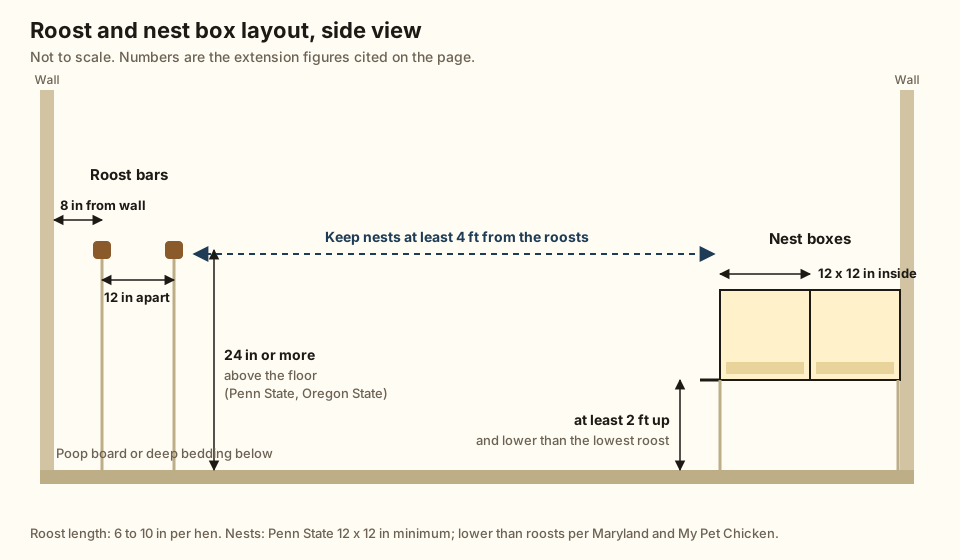
Ten to twelve inches between parallel bars. Penn State spaces them 12 inches apart and Oregon State 10, and the UK rule asks for at least 12 inches between perches and 8 inches between a perch and the wall (eXtension). Choose between a flat bed of bars at one height and a ladder that steps up. On a ladder, every hen tries for the top rung, and dominant hens take the higher perches at night. A flat bed keeps everyone at the same height and avoids long drops.
If you build a ladder anyway, offset the rungs back as well as up, so hens on the top bar do not drop manure on the hens beneath them. A ladder with rungs stacked straight up and only a few inches apart does exactly that. Keep the step between rungs small enough that hens hop down instead of flying, because big drops cause keel injuries.
Swipe sideways to see the whole figure, or open it full size.
Should the roost be higher than the nesting boxes?
Yes. Keep roosts higher than the nesting boxes, because hens roost on the highest point in the house (University of Maryland). My Pet Chicken gives the same rule on the nesting box dimensions page. A nest box above the roost turns into a bed full of manure. Oregon State’s bulletin reads the other way, but set the roost highest and keep nests at least 2 feet up, as Penn State does.
Plan the roost first, then the nests. Penn State also wants nests at least 4 feet from the roosts. In a small coop that usually means roosts on one wall and nests on the opposite one. The best nesting boxes guide helps once you know the space left.
Do you need a poop board under the roost?
You don’t need one, but it makes cleaning easier. Hens drop a lot of manure overnight, and it builds up under the roost while the rest of the bedding stays cleaner. A dropping board under the roost is common practice. Build it from wood, or from or covered in galvanized steel, aluminum, stainless steel or plastic. It collects manure free of bedding, which saves bedding (University of Kentucky Extension).
Manure builds up under roosts, and trays to collect it make cleaning easy (University of Minnesota). A dropping pit is the bigger version: wire covered, at least 12 to 16 inches off the floor, cleaned regularly and kept under a modest flow of air (Maryland). A roost over a screen with a removable area underneath keeps the coop cleaner too (Colorado State’s Boulder County brochure). Make the roosts themselves removable so you can clean out the manure under them (eXtension).
Apart from Maryland’s pit height, no extension source in this research gives poop board dimensions, so this page does not invent any. Size the board to the roost footprint, leave room for hens to step down onto the floor, and make sure you can scrape or lift it out. The chicken coop cleaning supplies guide covers scrapers and cleanup.
Feet and keel problems
Swollen feet, limping or a bent keel can come from perch design, but they can also be infection or injury. eXtension links perches to keel damage and fat pad lesions in research flocks. If a hen limps or has a hot, swollen foot, ask a vet who treats poultry before you change the roost.
When should chicks start using a roost?
Early. Birds reared without early access to perches struggle to use them as adults, so introduce perches while the birds are young (eXtension). A low bar a few inches off the brooder floor gives chicks practice. The chick brooder guide and when chicks can go outside cover the move to the coop.
Questions people ask
How high should a chicken roost bar be?
About 2 feet off the floor for standard hens. Penn State Extension and Oregon State Extension both give 24 inches, and the University of Minnesota sets a 12 inch minimum. Silkies need a roost only 1 foot off the ground (Oregon State).
How much roost space does each chicken need?
Plan on 8 to 10 inches per hen. Penn State gives 6 inches, Oregon State 5 to 10, the University of Minnesota 9 and Colorado State 6 to 12 depending on breed size. Larger breeds and cold climates where hens huddle sit at different ends of that range.
How far apart should roost bars be?
About 10 to 12 inches. Penn State spaces bars 12 inches apart and Oregon State 10 inches. The UK welfare rule quoted by eXtension sets at least 12 inches between perches and 8 inches from the wall.
What is the best wood for a chicken roost?
Square lumber with rounded top edges. Use 1 to 2 inch square lumber; poles that are too small or too round cause foot problems (Oregon State). Penn State uses 2 by 2 boards, and more hens use square perches than round ones (eXtension). Skip metal and plastic (University of Minnesota).
Should the roost be higher than the nesting boxes?
Yes. Keep roosts higher than the nesting boxes, because hens roost on the highest point in the house (University of Maryland). Oregon State EC 1644 reads the other way on nest height, but the roost-highest rule is the one to follow.
What is a poop board under a chicken roost?
A dropping board is a shelf or tray under the roost that catches overnight manure. It is common practice, it can be wood, metal or plastic, and it keeps manure out of the bedding so the bedding lasts longer (University of Kentucky Extension).
Sources
- Penn State Extension: Management Requirements for Laying Flocks
- Oregon State University Extension: Living on the Land, Backyard Chicken Coop Design (EC 1644, reviewed 2023)
- University of Minnesota Extension: Caring for chickens in cold weather
- eXtension Small and Backyard Poultry: Perches in housing for small and backyard poultry flocks (Dr. Jacquie Jacob)
- University of Kentucky Extension: AEN-167, Manure Management for Backyard Poultry
- University of Maryland Extension: Housing requirements
- Colorado State University Extension, Boulder County: Backyard poultry brochure
- University of Vermont Extension: Bulletin 2217, Winter Care of Your Laying Hens
- Washington State University Extension, Skagit County: Chicken basics handout

Written by Kyle
Kyle has kept backyard chickens on his own small farm for five years. He reads the extension research, the spec sheets and the owner complaints, then tells you what he would buy and what he would skip.
