On this page
- How do you know rats are in the coop?
- Why do rats move into chicken coops?
- How do you cut off the feed?
- How do you seal rats out of the coop?
- How do you trap rats safely around chickens?
- Is rat poison safe near chickens?
- Do rats kill chicks or eat eggs?
- Do natural rat repellents work?
- How do you clean up after rats?
- A two-week rat plan
To get rid of rats in a chicken coop, take the feed and low water away at night, seal every gap wider than 1/4 inch, and trap along the walls with snap traps set under a weighted crate the hens can’t reach. Sanitation, a tight building and trapping work together. Skip one and the rats stay.
This guide belongs to the predator-proofing guides. It covers the signs, the reasons rats pick a coop, the fixes in the order I’d do them, and what to do about poison. The building side lives in how to predator-proof a chicken coop, and the feeding station gets its own page on rat-proof chicken feeders.
Short answer
Starve, seal, then trapthe order Mississippi State and UC IPM extension programs use
Pull or close the feeder at dusk and store feed in a metal can with a lid. Close holes over 1/4 inch with hardware cloth or sheet metal. Then set rat-sized snap traps along the walls at night, under a crate staked or weighted down, and check them before the hens come out.
The short version
- One adult rat eats about 1 to 2 ounces of feed a day, or 23 to 46 pounds a year, and spoils more than it eats (Mississippi State Extension).
- Young rats squeeze under a door with a 1/2 inch gap, so seal every opening over 1/4 inch (UC IPM).
- Rats chew through plastic, foam, wood and caulk. Use metal: hardware cloth of 1/4 to 1/2 inch, steel wool or sheet metal (UC IPM, Utah State).
- Snap traps are the safest, most effective and cheapest way to trap rats. Set them only at night under a secured crate (UC IPM).
- Consumer rat poison now comes only in ready-to-use bait stations, and every rodenticide is toxic to poultry (US EPA, Mississippi State).
- For every rodent you see, expect another 20 to 50 you don’t (Mississippi State Extension).
How do you know rats are in the coop?
You see the damage before you see the rat. Rats feed at night and avoid new objects, so a coop can carry a colony for weeks before anyone spots one. Go out after dark with a flashlight. Night is the best time to judge how bad the problem is and where the traps should go (University of Maryland Extension).
| Sign | What it looks like | Rat or mouse? |
|---|---|---|
| Droppings | About 3/4 inch, bean-shaped with blunt ends, near feed and along walls | Rat. Mouse droppings look like grains of rice |
| Gnaw marks | Fresh chewing on feeders, door edges and corners, tooth marks about 1/6 inch wide | Rat. Mouse marks are about 1/12 inch scratches |
| Burrows | Holes along the coop base, under the floor, under the compost or woodpile | Norway rat, which nests 8 to 18 inches underground |
| Smudge marks | Dark, greasy streaks on beams and wall edges where fur rubs | Either, along a regular runway |
| Missing feed overnight | The feeder is lower in the morning than at roost time | Either. Hens don’t eat after dark |
| Strong ammonia smell, nest material piled in corners | Shredded litter, leaves or paper tucked behind boxes | Either |
| Missing eggs or chicks | Eggs gone or hollowed, chicks dead with head or neck wounds | Rat |
The table combines the sign lists from UC IPM, the University of Maryland and Mississippi State, and the predation signs from Utah State University Extension.
To estimate numbers, Mississippi State Extension uses a rough rule for poultry houses: signs but no sightings point to up to 100 rodents on the property, occasional night sightings to 100 to 500, and rats seen in daylight to a much bigger colony. A backyard coop is smaller than a broiler house, but the logic holds. If you see rats by day, you are past the stage where two traps will fix it.
Why do rats move into chicken coops?
A coop offers the three things a rat needs: food, water and a place to nest. Rodent numbers stay low when one of the three is missing, and a coop with an open feeder, a waterer on the floor and loose litter supplies all three (Mississippi State Extension). Once inside, rats burrow into dry litter, under caked litter, into dirt floors and into wall insulation.
The feed bill shows why rats stay. An adult rat eats 1 to 2 ounces of feed a day, and one laying hen eats about 0.25 pound a day (University of Kentucky). So a handful of rats eats a real share of what you buy for the flock, before counting what they foul.
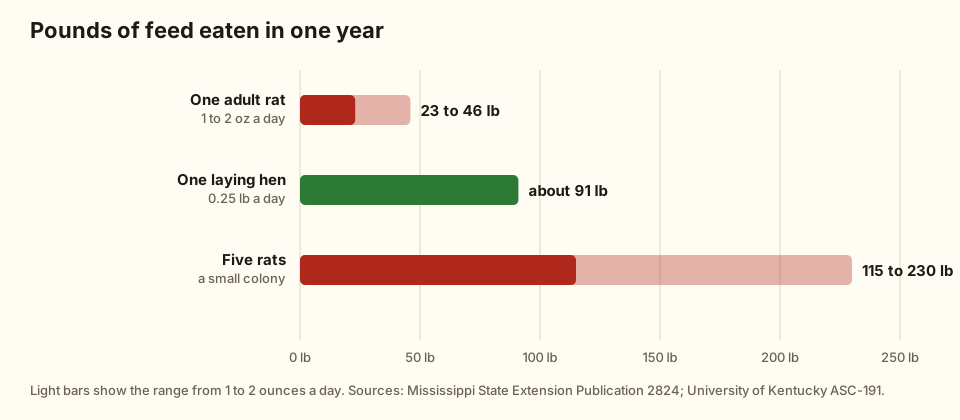
Swipe sideways to see the whole figure, or open it full size.
Rats also travel to the food. Norway rats forage 100 to 500 feet from the nest each night, and roof rats travel 300 feet or more (UC IPM). The rats in your coop might nest under a neighbor’s shed, so trapping the coop alone treats the symptom. Taking away the food treats the cause.
How do you cut off the feed?
Start here, because traps and poison fail as long as rats have an easier meal. Too much access to other food is one of the main reasons rat bait fails (Mississippi State Extension).
- Pull or close the feeder at dusk. Hens won’t eat or drink at night, and rats will, so take feeders and waterers out each night and put them back in the morning (Utah State Extension).
- Store feed in a metal can with a tight lid. Rodents chew through wood faster than plastic and plastic faster than metal (Utah State). Feed keeps up to a month stored cool and dry in metal cans (Penn State Extension).
- Clean up spilled feed every day, inside the coop and under the run feeder. Adjust the feeder so hens can’t rake feed onto the floor (University of Maryland).
- Switch to nipple drinkers or raise the waterer. Nipple drinkers make it hard for rodents to get water (University of Maryland), and the chicken nipple waterer guide covers setup.
- Give treats in a pan and only what the flock finishes before roost time.
- Collect eggs at least once a day so the nest boxes don’t become a food source.
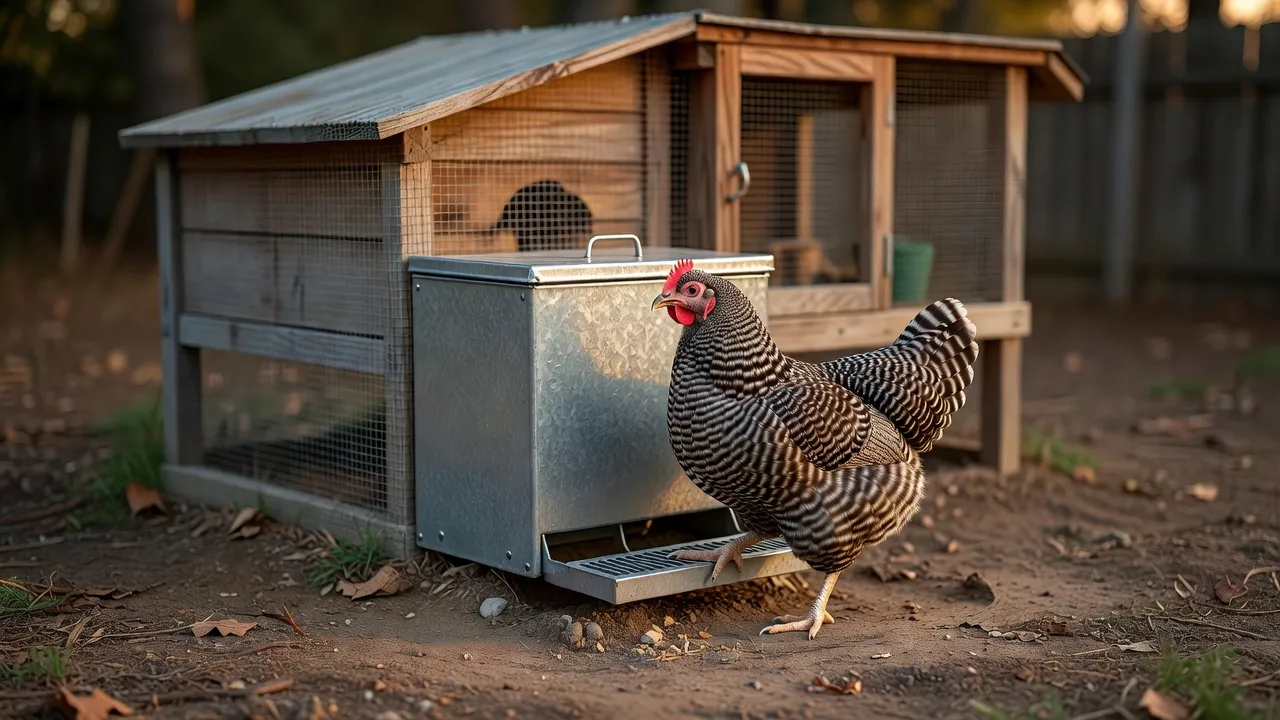
If pulling the feeder every night won’t happen in your house, buy a feeder that closes itself. A treadle feeder keeps its lid shut until a hen steps on the platform. No maker guarantees it against rats, and the trigger weight matters: Grandpa’s Feeder publishes about 14 oz for its Standard size and about 2 lb for its Large, while adult Norway rats weigh 7 to 18 oz (UC IPM). For two to four hens, the Roamwild PestOff closes its two ports on springs and needs no training. The rat-proof chicken feeder comparison lines up the trigger weights, capacities and prices.
See feeder sizes and priceHow do you seal rats out of the coop?
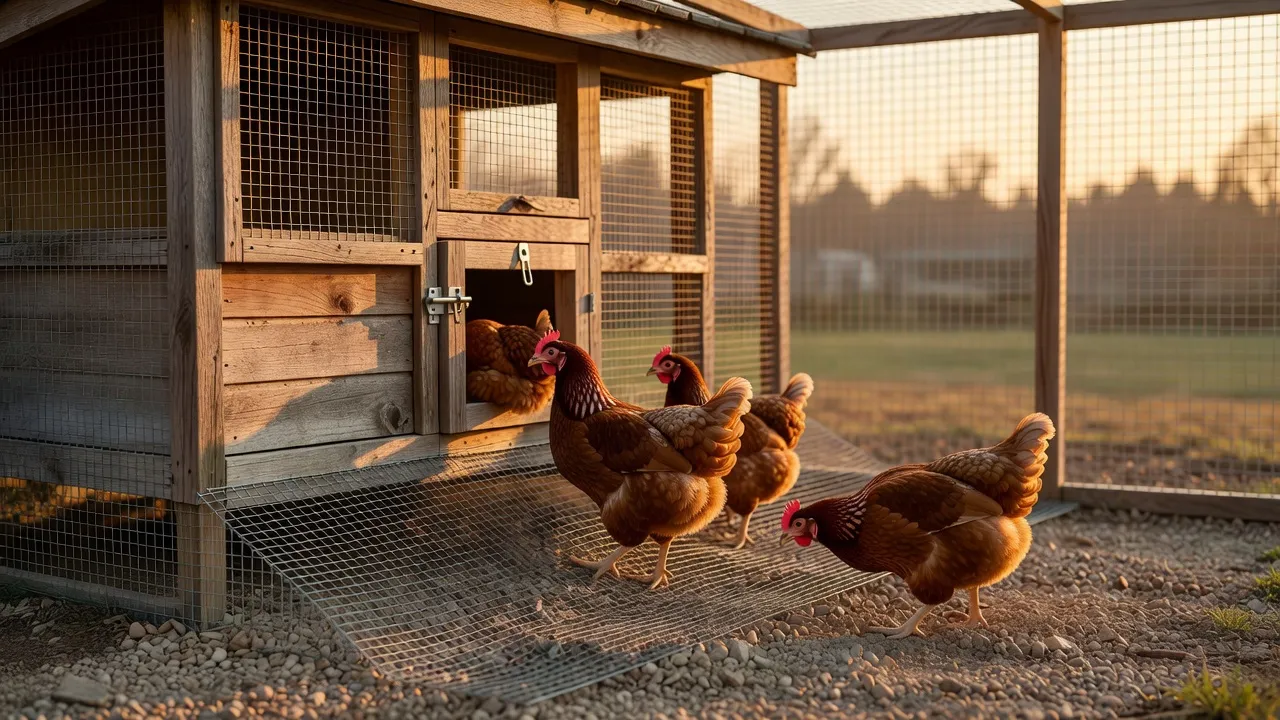
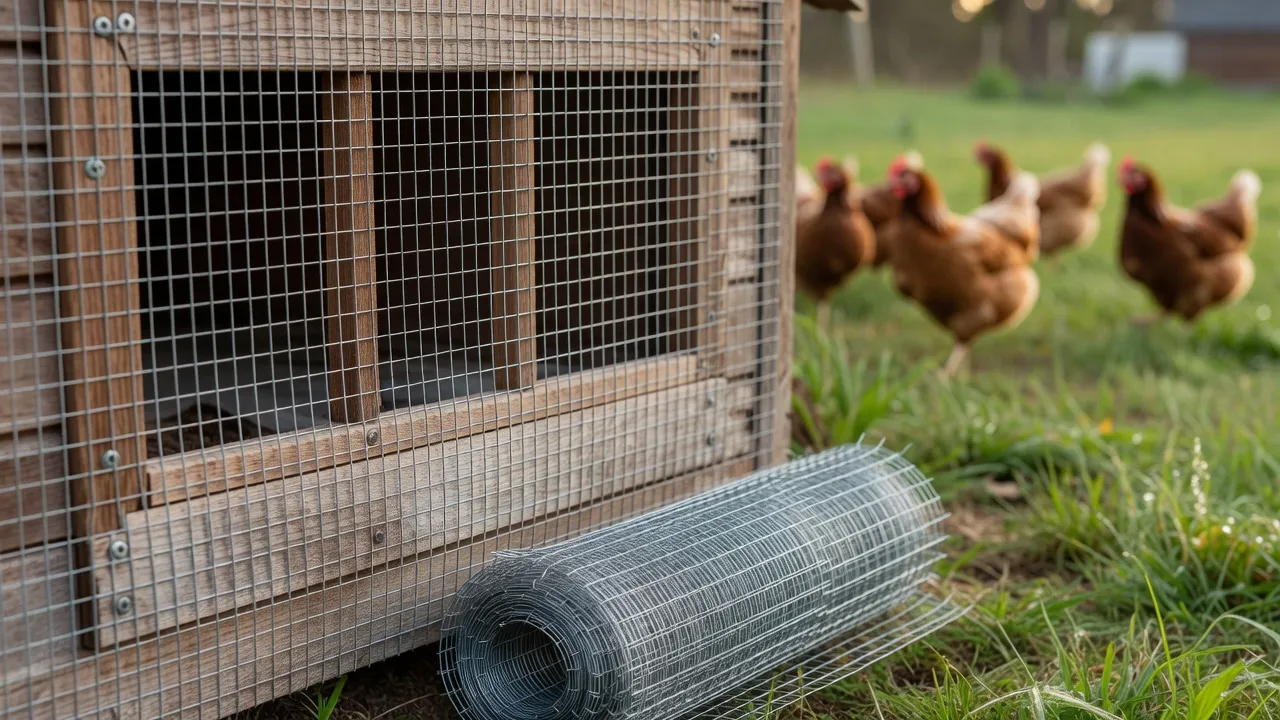
Close every hole larger than 1/4 inch. Rats get through any hole their head fits, about 1/2 inch for a rat and 1/4 inch for a mouse (Mississippi State), and young rats squeeze under a door with a 1/2 inch gap (UC IPM). Chicken wire keeps hens in. It doesn’t keep rats out, because rats bite through the thin wire and smaller rodents walk through the holes (Utah State).
| Weak spot | Fix | Spec |
|---|---|---|
| Vents and windows | Hardware cloth screwed to the frame | 1/4 to 1/2 inch mesh (Utah State); 19-gauge 1/2 inch galvanized wire cloth for windows near the ground (UC IPM) |
| Small holes and cracks | Steel wool packed in, caulk or spray foam around it to hold it | CDC seal-up guidance |
| Larger holes, gnawed corners | Hardware cloth, sheet metal or cement cut to fit | CDC; staple hardware cloth over fresh gnawing (Utah State) |
| Door gaps | Door sweep, sheet metal along chewed edges | Gap under 1/2 inch, ideally under 1/4 inch (UC IPM) |
| Under the coop | Raise the coop at least 1 foot so nothing nests underneath, or use a solid floor | Oregon State Extension |
| Ground at the walls | Concrete floor with the wall started on one or two blocks, or a buried skirt or apron of hardware cloth | Penn State; Utah State |
| The yard around it | Mow, clear brush and junk, keep a 3 foot clear strip around the coop | Mississippi State |
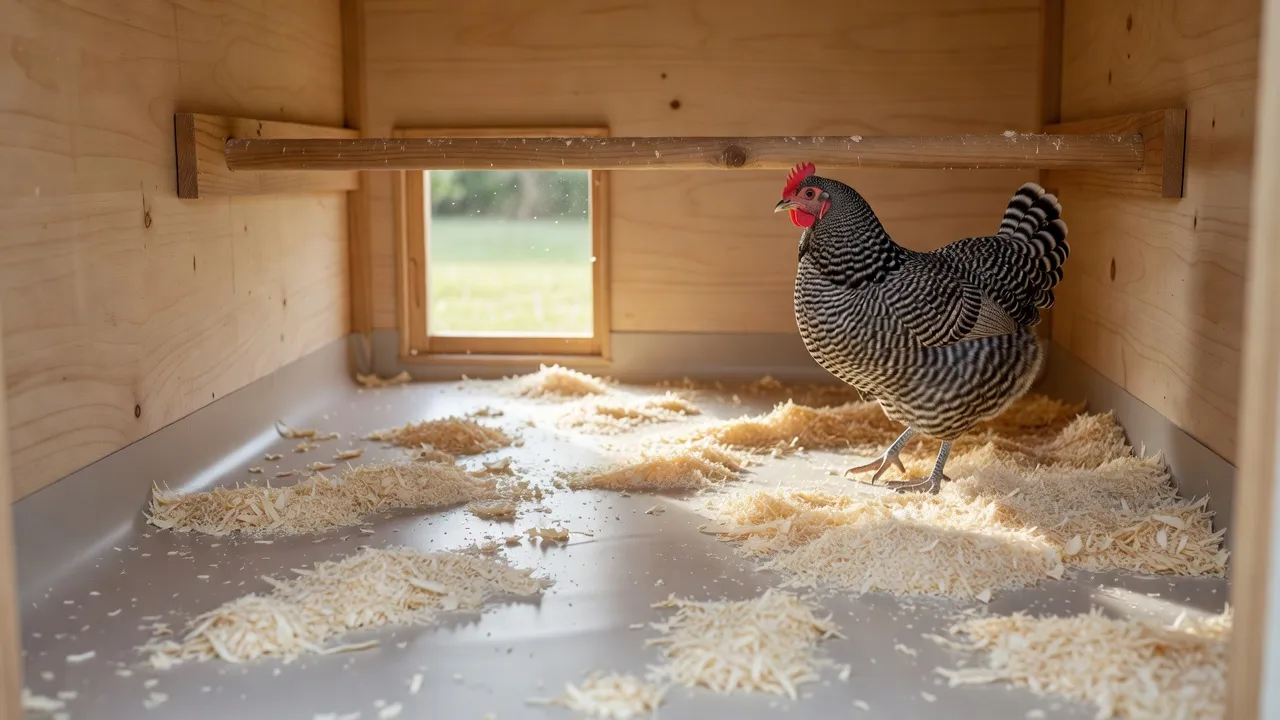
A floor is the layer most coops get wrong. Rats burrow into dirt floors and under loose litter, so a coop sitting on soil needs wire under it or a solid floor. The chicken coop flooring guide compares concrete, sealed plywood and dirt with wire, and the hardware cloth guide covers mesh size, gauge and how to fasten it.
Trim plants away from the coop as well. Dense shrubs, ivy and woodpiles give rats cover, so leave at least 2 feet between shrubs and buildings (UC IPM).
How do you trap rats safely around chickens?
Use rat-sized snap traps, set at night, under a crate the hens can’t enter. Snap traps are the safest, most effective and most economical way to trap rats (UC IPM), and they beat glue traps and live traps, which scare rodents into urinating and raise your own risk of illness (CDC). A mouse trap won’t hold a rat, so buy the right size.
- Prebait first. Rats fear new objects, so put the traps out baited but unset for a couple of days, until the bait has been taken several times (UC IPM). Use a pea-sized amount of peanut butter, nuts or dry pet food.
- Set traps only after the hens roost, and leave them unset in place by day. Night trapping keeps daytime animals, birds included, out of the traps (UC IPM IPM News, Winter 2019).
- Cover each trap with a crate that is staked or weighted down, so nothing larger than a rat reaches it. Pick a crate with openings too small for a hen’s head.
- Put traps along walls and runways, trigger end against the wall so the trap forms a “T” with it (CDC). Rats run along edges.
- Use plenty of traps, about 10 to 20 feet apart. If bait vanishes from all of them, double the number (UC IPM).
- Check and clear every trap in the morning, before you open the pop door. Wear gloves.
- Keep trapping for a few weeks after the last catch. Rats breed fast, and more move in while food remains.
| Method | Works on rats? | Risk to hens | Verdict |
|---|---|---|---|
| Rat snap trap under a weighted crate, set at night | Yes, the extension first choice | Low if hens can’t reach it and traps are cleared by morning | Use it |
| Electronic rat trap | Yes, needs prebaiting | Low inside a covered station | Good, but costs more than snap traps (UC IPM) |
| Bait station with rodenticide | Yes | Primary and secondary poisoning risk | Outside the run only, as a last resort |
| Glue board | Hard to use on rats | Can catch birds and small animals; never outdoors (UC IPM) | Skip |
| Live trap | Catches them, but release is not recommended | Low | Skip. A released rat stays a health problem for you and your neighbors (UC IPM) |
| Ultrasonic or scent repellent | No lasting effect | None | Skip (UC IPM) |
| Barn cat | Kills some | Depends on the cat | No substitute for exclusion; rats outbreed predators (UC IPM) |
Is rat poison safe near chickens?
Not inside the coop or run, and not where a hen can reach a dead rat. All rodenticides are poisonous at some level to poultry, livestock, wildlife and people (Mississippi State Extension). Slow-acting anticoagulants also mean a dead rat can hold several lethal doses, so any animal that eats the carcass can be poisoned too (UC IPM).
The rules already limit what you can buy. Products sold to consumers come as ready-to-use bait stations with block or paste bait, and pelleted baits are no longer allowed in consumer products. The stronger second-generation anticoagulants, such as brodifacoum and bromadiolone, are registered only for professional and agricultural use (US EPA). Consumer stations carry labels for indoor use, or indoor and outdoor use within 50 feet of buildings, so read the label for the spot you have in mind.
If you bait at all
Put the bait station outside the run, fastened down, in a spot no hen can reach. Bait outside a station leaves you liable if another animal eats it (University of Maryland Extension). Pick up dead rodents every day, keep the product label and the poison control number handy, and wear gloves. In California, most anticoagulant baits are banned for this use (UC IPM).
I’d treat poison as a sign the first three steps aren’t finished. If rats still get in after you’ve pulled the feed and sealed the coop, call a licensed pest control operator, who can use products and methods a homeowner can’t.
Do rats kill chicks or eat eggs?
Yes. Rats prey on chicks and eggs, and in a heavy infestation they attack young and adult birds at night, biting the head or neck and dragging parts of the bird into a burrow (Utah State University Extension). Roof rats list young birds and bird eggs among their preferred foods (UC IPM).
Chicks need the tightest setup on the property. Brood them indoors or in a brooder closed with 1/4 inch hardware cloth, and wait on the move outside until the coop is sealed. The guide on when chicks can go outside covers the age and night temperatures. Collect eggs every day, and twice when you can.
Do natural rat repellents work?
No repellent has solved a rat problem for more than a short time, and California has no truly effective rat repellent registered (UC IPM). Ultrasonic devices stop working once rats get used to the sound. Peppermint oil, mothballs and dryer sheets fall into the same group: they don’t touch the food, water and shelter that keep rats in your coop.
Predators don’t fix it either. Cats and owls eat rats, but rats breed too fast for predators to control them, and cat food left outside feeds rats too (UC IPM). A Norway rat female raises 20 or more young a year.
“Naturally” works when it means no poison: remove feed at night, seal the building, trap. That is the whole extension program.
How do you clean up after rats?
Rodents carry up to 45 diseases, including leptospirosis, salmonellosis, fowl pox and erysipelas (University of Maryland Extension), so clean the coop as if it were contaminated.
- Open the coop and let it air for 30 minutes before you start (CDC).
- Wear rubber or plastic gloves.
- Spray droppings, nests and dead rodents with a disinfectant, or 1 part bleach to 9 parts water, until very wet. Let it soak 5 minutes (CDC).
- Wipe up with paper towels. Don’t sweep or vacuum droppings, because that puts dust in the air you breathe (CDC).
- Double-bag dead rodents and nest material and put them in a covered trash can.
- Wash gloved hands, remove the gloves, then wash your hands with soap and warm water.
Then replace the litter in the affected area and check for the hole the rats used. The coop cleaning supplies guide lists the tools.
Not vet advice
Call your vet if birds go off feed, lose weight or show diarrhea after a rat problem. Rats carry poultry diseases such as salmonellosis and pasteurellosis (Mississippi State Extension).A two-week rat plan
| When | What to do |
|---|---|
| Day 1 | Walk the coop at night with a flashlight. Note droppings, holes and runways |
| Day 1 | Move feed into a metal can with a lid. Start pulling or closing the feeder at dusk |
| Days 2 to 3 | Seal holes over 1/4 inch with hardware cloth, steel wool or sheet metal. Clear the 3 foot strip around the coop |
| Days 2 to 4 | Put rat snap traps under staked crates along the walls, baited but unset |
| Day 5 onward | Arm the traps after the hens roost. Clear them every morning before letting the flock out |
| Week 2 | Look for new gnawing. Patch fresh holes the same day. Add traps where bait disappears |
| After the last catch | Keep the night routine and a few prebaited traps in place |
Questions people ask
What kills rats in a chicken coop without hurting the chickens?
Rat-sized snap traps set at night under a weighted or staked crate, with an opening too small for a hen. Prebait the traps unset for a couple of days, arm them after the hens roost and check them before you open the pop door. That keeps the traps out of the flock's reach and avoids poison inside the run.
Will rats kill chickens?
Rats prey on chicks and eggs first. In a heavy infestation with little other food, they raid coops at night and attack young and adult birds, killing by biting the head or neck (Utah State University Extension). Close chicks in a hardware-cloth brooder and collect eggs every day.
Should I take the chicken feed away at night?
Yes. Hens don't eat or drink after they roost, and rats do. Pull or close the feeder and lift ground-level water at dusk, then put both back in the morning. A treadle feeder that stays shut when no hen stands on it does the same job.
Is it safe to use rat poison around chickens?
Not inside the coop or run. Every rodenticide is toxic to poultry, and a poisoned rat can carry several lethal doses, so a hen that pecks a dying rat is at risk too. If trapping and sealing fail, use a tamper-resistant bait station labeled for that spot, outside the run, and pick up dead rodents daily.
How do I get rid of rats in a chicken coop naturally?
Natural control means removing food, water and shelter, sealing the coop and trapping. Repellent sprays and ultrasonic boxes don't solve a rat problem for long, and a barn cat can't keep up with how fast rats breed. Clean, tight and trapped beats any scent.
How do I tell rat droppings from mouse droppings?
Rat droppings run about 3/4 inch long and look like a bean with blunt ends. Mouse droppings are the size of a grain of rice. Rat gnaw marks are also wider, about 1/6 inch against a mouse's 1/12 inch scratches.
Sources
- UC Statewide IPM Program: Pest Notes, Rats (updated June 2025)
- UC IPM Retail Nursery and Garden Center IPM News: Snap traps for controlling rats and mice (Winter 2019)
- Mississippi State University Extension: Controlling rodents on the poultry farm (Publication 2824, 2014)
- University of Maryland Extension: Rodent control on small poultry farms (FS-985)
- Utah State University Extension: Backyard chicken ranching, rodents and COVID-19 (January 2021)
- CDC: How to trap up to remove rodents
- CDC: How to seal up to prevent rodents
- CDC: How to clean up after rodents
- US EPA: Restrictions on rodenticide products
- Penn State Extension: Small-scale poultry housing (updated June 2026)
- Oregon State University Extension: Backyard chicken coop design (EC 1644, reviewed 2023)
- University of Kentucky Extension ASC-191: How much will my chickens eat?

Written by Kyle
Kyle has kept backyard chickens on his own small farm for five years. He reads the extension research, the spec sheets and the owner complaints, then tells you what he would buy and what he would skip.