On this page
- Quick picks
- How I chose these feeders
- Best overall and best no-waste port feeder
- Best treadle feeder
- Best for a small flock that has rats
- Best large chicken feeder for a big flock
- Best metal trough with a rain hood
- Best budget feeder for small birds
- How big a feeder do you need?
- Which feeder type wastes the least?
- Feed, water and the rest of the setup
The best chicken feeder for most backyard flocks is a covered feeder with hooded ports or a lid, sized to hold about a week of feed and set at back height. A laying hen eats about a quarter pound a day (University of Kentucky), so the feeder should hold hens times days times 0.25 lb and keep that feed dry. Below are six picks from the makers’ own spec pages with owner complaints linked, a sizing table, and a straight look at which feeder designs waste the least.
Quick picks
The right pick depends on flock size and whether your trouble is spilled feed, rain or rats. Capacity is the maker’s number, and the “hens for 7 days” column divides it by 1.75 lb, which is one hen’s week of feed at 0.25 lb a day, rounded down.
| Feeder | Type | Capacity | Hens for 7 days | Rain cover | Rodent claim | Price, checked 2026-10-09 |
|---|---|---|---|---|---|---|
| RentACoop 25 lb 4-Port Bucket | Port bucket | 25 lb | about 14 | Hooded ports, lid | Covers close at night | $69.95 |
| Grandpa’s Feeder | Treadle | 20 lb or 40 lb | about 11 or 22 | Weight-activated lid, no weatherproof guarantee | Makes feed harder to reach, no guarantee | $189.99–$239.99 |
| Roamwild PestOff | Spring-loaded ports | 8 lb | about 4 | Maker says weatherproof | Maker says pest-proof by design | $49.99 |
| RentACoop 65 lb Flock Feeder | Six-port | 65 lb | about 37 | Rain hoods, peaked lid | None claimed | $159.95 |
| RentACoop 25 lb Trough with Lid | Trough | 25 lb | about 14 | Removable rain hood | Maker says it deters pests | $89.95 |
| RentACoop 10 lb 4-Port | Port bucket | 10 lb | about 5 | Covered ports | Covers close at night | $42.95 |
How I chose these feeders
I ranked these on published specs, extension intake data and linked owner reviews, and I write “not stated” when a maker leaves a number out. I have not run a controlled comparison of any of them. Every rodent claim below is the maker’s, and none comes with independent data. What I care about most is capacity against flock size, whether the ports and lid are covered, what the body is made of, and what owners complain about most.
Best overall and best no-waste port feeder
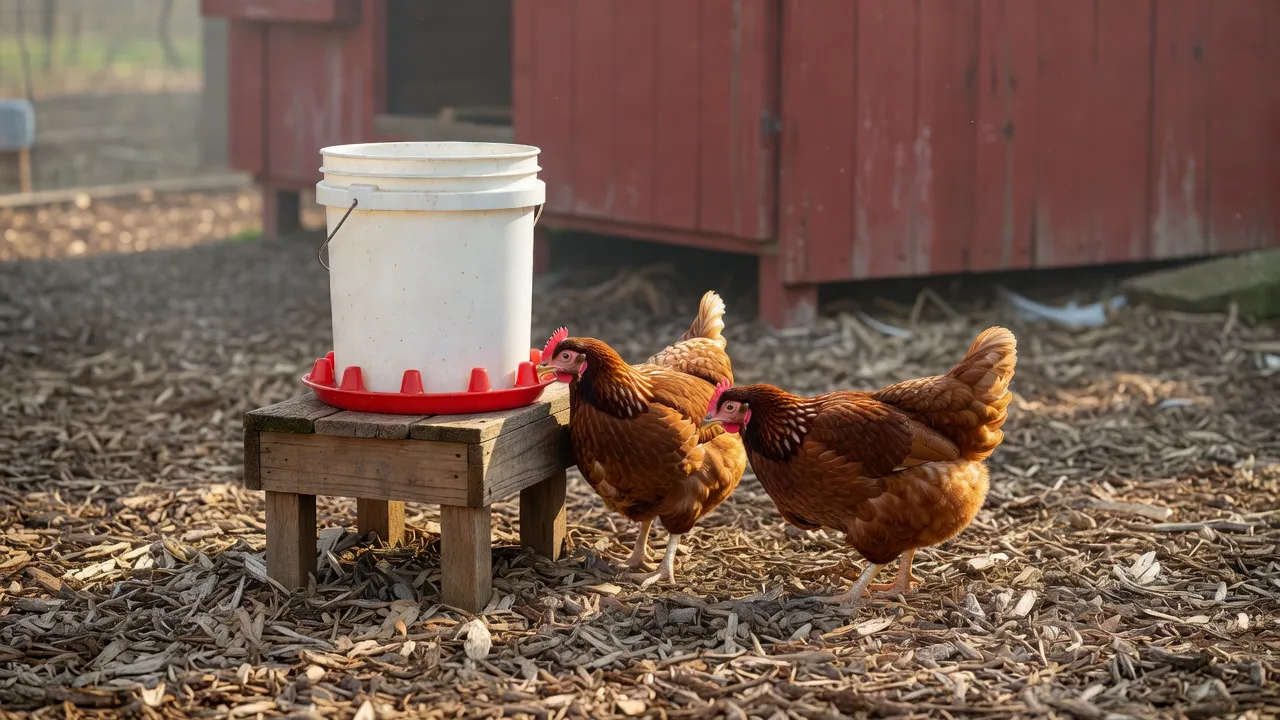
The RentACoop 25 lb port feeder is the best chicken feeder for most flocks of 6 to 14 hens because it covers its ports, steers feed down with an interior diverter and costs about $2.80 per pound of capacity. No feeder is truly no-waste, because hens still scratch, but the hood and the diverter go after scatter at the opening. The catch is the plastic body, which owners say does not last forever outdoors.
RentACoop 25 lb 4-Large-Port Bucket Feeder
6 to 14 adult hens that scatter feed from open troughs
- Capacity
- 25 lb
- Ports
- 4 large, with sliding covers
- Waste control
- Hooded ports and an interior feed diverter
- Mounting
- Adjustable stand, screwed down in a coop or staked outdoors
- Bird age
- 12 weeks and older (listing address)
- Dimensions
- Not stated
- Hooded ports and a diverter cut scatter
- Sliding port covers close at night
- About $2.80 per pound of capacity
- Lid with a carry handle
- Plastic body that owners say goes brittle outdoors
- Owners report mice reaching feed through the ports
- Dimensions and body material not stated by the maker
What owners report
Reviewers on the RentACoop listing say the plastic fell apart within about a year in one case and about two and a half years in another. Others say the lid is hard to open, mice got in through the ports, and the port openings rubbed feathers off some birds' necks.
Best treadle feeder
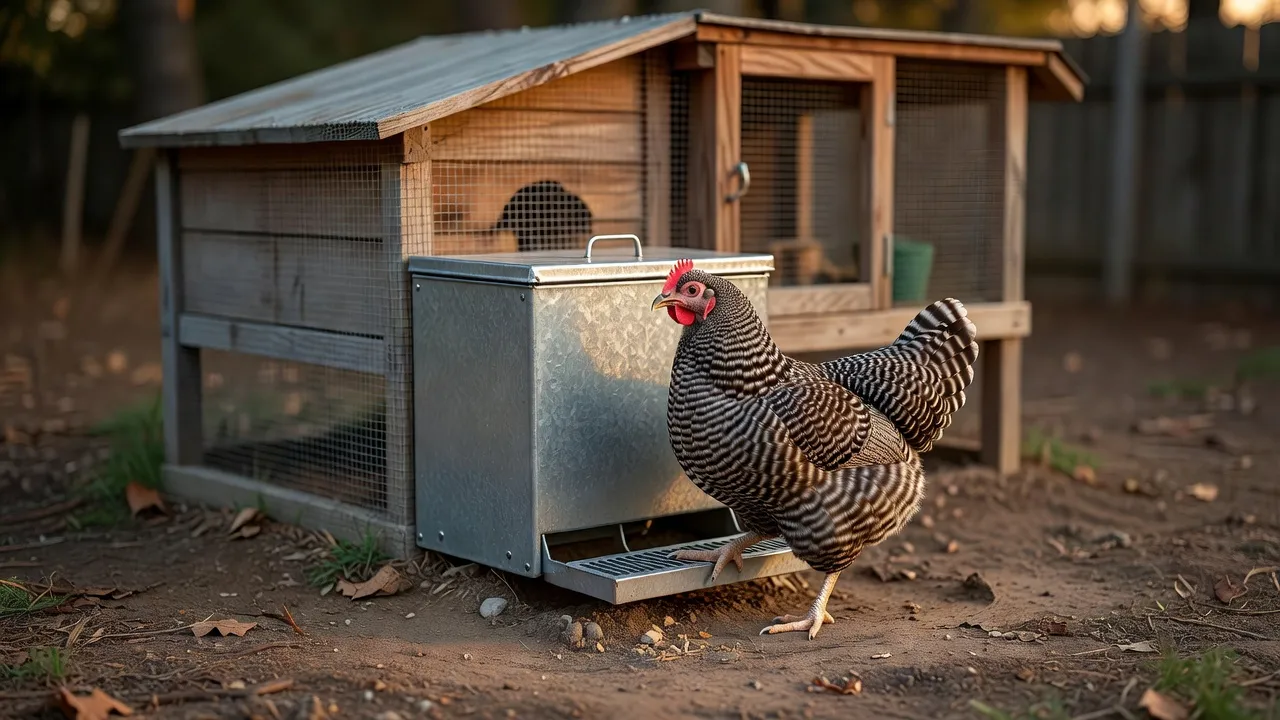
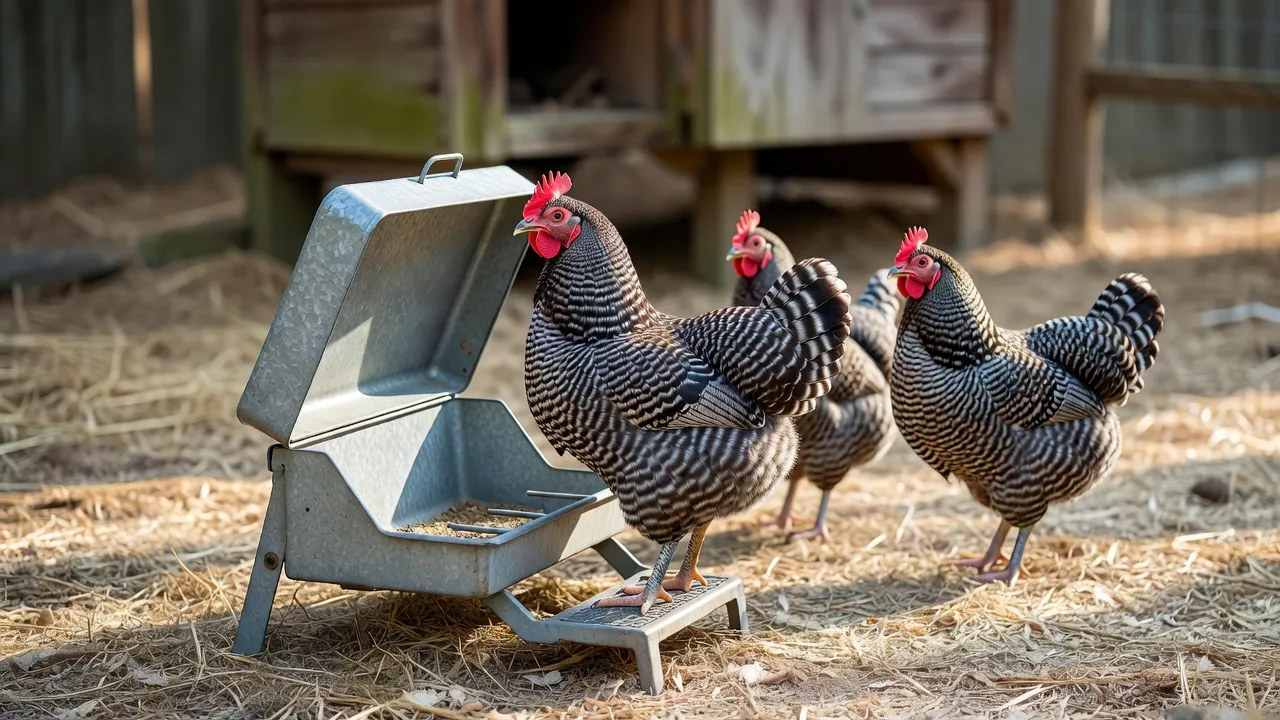
Grandpa’s Feeder is the best treadle chicken feeder because the maker publishes activation weights, a two-stage training plan and honest limits. Its galvanized steel body and weight-activated lid keep feed closed whenever no hen is standing on it. It costs about three times the port feeder above, so buy it for rat or wild-bird pressure, not for waste alone. The treadle feeder guide covers how they work and how to train hens.
Grandpa's Feeder Treadle Feeder
a flock with rats or wild birds at the feeder, and an owner who will train hens for about two weeks
- Capacity
- Standard about 20 lb, Large about 40 lb
- Activation weight
- Standard 14 oz (500 g), Large 2 lb (900 g), approximate
- Maker's flock size
- Standard up to 12 hens, Large 12 or more
- Body
- Galvanized steel with a weight-activated lid
- Training
- Two stages of about one week each
- Not for
- Baby chicks
- Maker publishes activation weights
- Galvanized steel body
- Lid closes when no bird is on the treadle
- Maker lays out a training plan
- Highest price on this page
- Maker says it is not a guarantee against rats, wildlife or weather
- Maker does not address bantams
- Needs about two weeks of training
What owners report
The maker's page carries no customer reviews. Keepers in a Facebook backyard poultry group name Grandpa's among popular rat-proof options and also recommend metal bins and supervised feeding.
Best for a small flock that has rats
The Roamwild PestOff is the best pick for two to four hens with a rat problem, because it holds the feed behind two spring-loaded ports that open under a hen’s weight and costs $49.99. The maker says it needs no adjustment or training. It holds 8 lb, which feeds four hens for about a week, so it suits a small backyard flock and not a big one.
Roamwild PestOff Rat Proof Chicken Feeder
2 to 4 hens where rats are the main worry
- Capacity
- 8 lb (4 L)
- Ports
- 2 spring-loaded, weight-activated
- Size
- 15.7 × 8.3 × 8.3 in
- Material
- Metal components (maker's wording)
- Weather
- Maker says weatherproof
- Trigger weight
- Not stated
- Costs about a quarter of Grandpa's low-end price
- No training needed, per the maker
- Tool-free disassembly for cleaning
- Only 8 lb, about 16 days for two hens
- Trigger weight and bantam suitability not stated
- Pest-proof claim comes with no independent data
- Two ports limit how many hens eat at once
Best large chicken feeder for a big flock
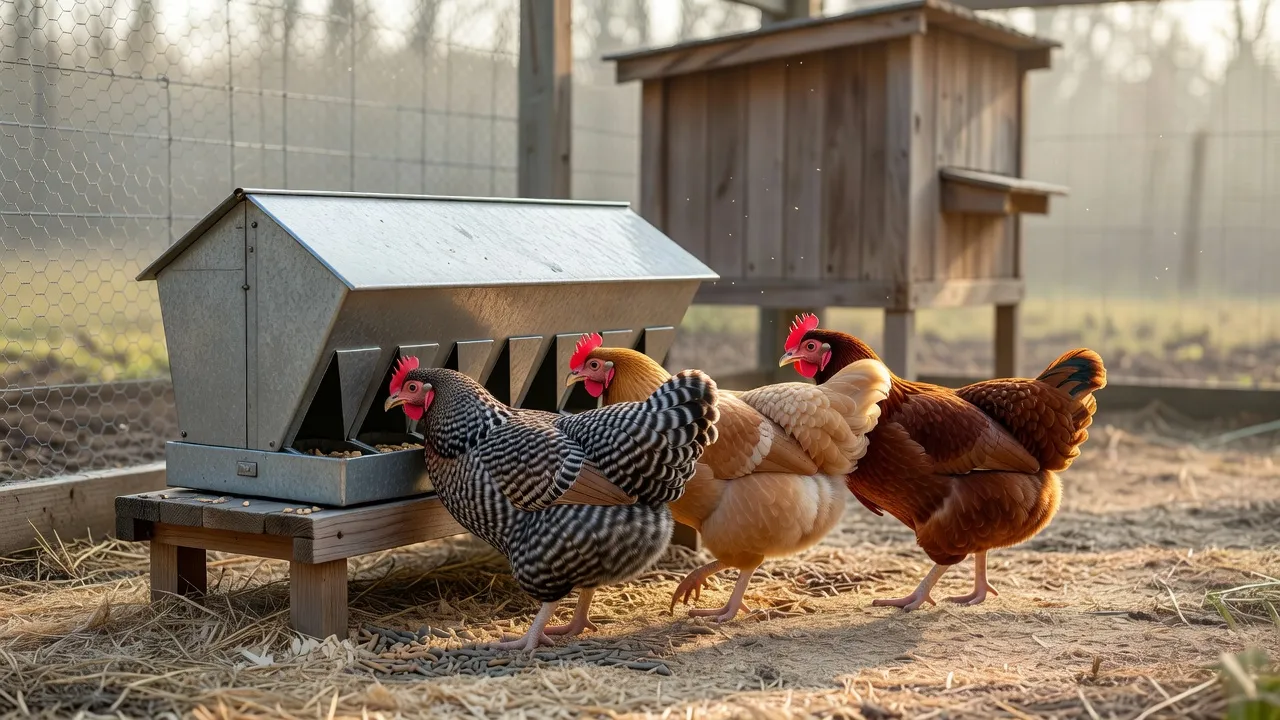
The RentACoop 65 lb flock feeder is the best large chicken feeder here because it holds enough for 20 hens for about 13 days at 0.25 lb a day and puts rain hoods over six ports. It is a feeder for birds over 12 weeks old. Owners report shipping dents, pellets that will not flow and condensation inside, so check the unit the day it arrives.
RentACoop 65 lb 6-Port Flock Feeder
12 to 30 hens that you want to feed every week or two
- Capacity
- 65 lb
- Ports
- 6 large, with rain hoods
- Waste control
- Covered ports and internal feed diverters
- Cover
- Peaked lid
- Stand
- Four adjustable legs
- Bird age
- Over 12 weeks
- Holds about 13 days of feed for 20 hens
- Rain hoods and a peaked lid
- Raised legs keep it off damp ground
- Port covers are not in the box, per the listing
- Owners report feed that will not flow
- Ports run small for large-combed breeds, per an owner
- Can tip when nearly empty
What owners report
Reviewers on the RentACoop listing report units arriving dented, pellets and fine powder not dropping into the ports, condensation that molded feed in the bottom corners, and a lid that a raccoon removed. One warns that a hen's neck was injured when the feeder was nearly empty and tipped, and another found day-old chicks trapped inside, so keep it for adult birds.
Best metal trough with a rain hood
The RentACoop 25 lb galvanized trough is the pick if you want all metal and a rain hood instead of a plastic bucket. The maker builds it from galvanized sheet metal with stainless steel screws, adds a magnetic lid, and says it is designed to minimize waste. Owners say hens can still make a mess.
RentACoop 25 lb Galvanized Trough Feeder with Lid
6 to 14 hens in a coop or run where plastic would not last
- Capacity
- 25 lb (10 lb and 50 lb sizes also sold)
- Body
- Galvanized sheet metal, stainless steel screws
- Cover
- Removable rain hood and magnetic lid
- Cleaning
- Interior grate clips up and out of the way
- Not for
- Chicks
- Dimensions
- Not stated
- All-metal body
- Rain hood keeps feed dry indoors or out
- Grate clips out for cleaning
- Owners say hens still spill feed
- Feed can stick and need a push to flow
- No legs or stand offered
- Maker's only rodent claim is that it deters pests
What owners report
Reviewers on the RentACoop listing say chickens can still make a mess, units arrive dented, crumbles jam in the gravity feed, and the hens ignored the feeder at first because of feed on the ground.
Best budget feeder for small birds
The RentACoop 10 lb port feeder is the cheapest covered option here at $42.95, and the listing pitches it at small to medium adult chickens and chicks as young as 3 days. Owners say the ports are too small for full-grown hens and that rain protection is mixed, so buy it for bantams or a pair of small hens and not a mixed flock.
RentACoop 10 lb Chick2Chicken 4-Port Feeder
bantams or 3 to 5 small hens
- Capacity
- 10 lb
- Ports
- 4 medium, with sliding covers
- Waste control
- Feed diverter, covered ports and a hooded design
- Extras
- Anti-roost cone, adjustable stand
- Birds
- Chicks from 3 days to small or medium adults, per the listing
- Dimensions
- Not stated
- Lowest price of the covered feeders here
- Anti-roost cone included
- Covers shut at night
- Owners say the ports are too small for full-grown hens
- Reviews conflict on rain protection
- Body material and dimensions not stated
What owners report
Reviewers on the RentACoop listing disagree about rain: some say feed stays dry and one says water got in. Several say the ports are too small for full-grown hens.
How big a feeder do you need?
Multiply hens by days by 0.25 lb. Six hens for a week need 10.5 lb, and ten hens for a week need 17.5 lb. Alabama Extension puts a hen at 100 to 150 grams a day, so 10 hens finish a 50 lb bag in about 20 days.
| Hens | 3 days | 7 days | 14 days |
|---|---|---|---|
| 4 | 3 lb | 7 lb | 14 lb |
| 6 | 4.5 lb | 10.5 lb | 21 lb |
| 10 | 7.5 lb | 17.5 lb | 35 lb |
| 12 | 9 lb | 21 lb | 42 lb |
| 20 | 15 lb | 35 lb | 70 lb |
Hens that sit at the top of Alabama’s 100 to 150 gram range eat about a third more than the table. Use 0.33 lb a day instead, which turns 10 hens for a week into about 23 lb. Free-ranging birds eat more as well (University of Kentucky).
Space matters as much as capacity. Utah State Extension allows 2 to 3 linear inches of feeder per adult bird, so 12 hens need 24 to 36 inches of feeding width. Count the ports or trough edge, and add a second feeder if the low-ranking hens get pushed off. Set the bottom of the feeder at about back height (Alabama Extension) and place it so birds cannot roost on it.
Which feeder type wastes the least?
A covered feeder with hooded ports or a weight-activated lid wastes the least, and an open trough or a pan on the ground wastes the most. Nobody has published measured waste for these exact models, so this ranking follows how each design works.
| Type | Why it wastes less or more | Rain | Rodents |
|---|---|---|---|
| Open hanging trough | Hens can reach in and flick feed over the lip | Open to the weather unless it has a hood | Open all night |
| Trough with lid | Lid and grate slow scatter, owners still report spills | Rain hood on the model above | Lid closed only if you close it |
| Hooded port bucket | Hoods and diverters cut scatter at the opening | Hooded ports, mixed owner reports | Covers shut at dusk if you close them |
| Treadle | Lid closes when no hen is on it, hens can still rake feed from the trough | Maker-dependent | Harder to reach, not a guarantee |
| Spring-loaded ports | Ports stay shut for lighter animals | Maker says weatherproof | Maker says pest-proof by design |
Dine-A-Chook, which sells a competing feeder, argues that a treadle box still lets hens rake feed out and that a floating steel grate reduces waste without eliminating it (Dine-A-Chook). Read that as a competitor’s view, and note that it matches the owner reports on the trough above.
DIY is the other route. In a Facebook thread on feeder systems for a large flock, one keeper says they use several 6 inch PVC pipes with U-shaped joints at the bottom, and a thread on feeders for 9 chickens describes 5-gallon bucket feeders with DIY kits as popular for cutting daily filling. Neither thread measures waste, so treat both as owner ideas.
The feed matters too. Alabama Extension says adult chickens waste more feed when they eat crumbles. The University of Kentucky says pelleted feed means less spillage and less waste (source). If waste is your problem, change to pellets before you spend $200 on a feeder, and do not fill any feeder to the brim.
Feed, water and the rest of the setup
Feed and water go together. Chickens drink about twice as much water as they eat by weight (University of Kentucky), so ten hens eating 2.5 lb of feed a day drink about 5 lb, or 2.5 quarts. Pair the feeder with one of the best chicken waterers, and keep both clear of the coop corners where rats travel. Rats eat what is abundant, and Norway rats favor cereal grains (UC IPM), so spilled feed anywhere near the coop is an invitation. The rest of the fix is a coop rats cannot enter, which the predator-proof coop guide covers. If rats are your main problem, start with the rat-proof chicken feeder guide. The full set of feeder guides lives in the chicken feeder hub.
Questions people ask
How much feed does a chicken eat per day?
A laying hen eats about a quarter pound of feed a day, according to University of Kentucky Extension. Alabama Extension gives 100 to 150 grams, which is 0.22 to 0.33 pounds. Free-ranging birds eat more, so size up if yours forage hard.
What chicken feeder wastes the least feed?
By design, a covered feeder with hooded ports or a weight-activated lid wastes the least, because hens cannot rake feed out over an open lip. Pellets spill less than crumbles (University of Kentucky, Alabama Extension), and a feeder with its bottom at about back height wastes less than one on the ground. No one has published measured waste for these exact models, so treat the ranking as design logic.
How big a feeder do I need for 10 chickens?
Ten hens eat about 2.5 pounds a day, so a feeder that lasts a week needs to hold about 17.5 pounds. It also needs 20 to 30 linear inches of feeding space, because Utah State Extension allows 2 to 3 inches per adult bird. A 25 lb feeder lasts those ten hens about ten days.
Should I leave the chicken feeder out at night?
I would pull it or close it at dusk. Hens roost after dark, and UC IPM says rats are mostly active at night and advises bringing outdoor food inside at night, so an open feeder feeds them instead. A feeder with closing ports or a weight-activated lid does this for you. The rat-proof feeder guide covers the rest of the fix.
Do treadle feeders stop rats?
They make feed harder for rats to reach, but no maker guarantees it. Grandpa's Feeder states on its own page that it is not a universal rat-proof guarantee. Read the treadle feeder guide for activation weights and training.
Sources
- University of Kentucky Extension ASC-191: How much will my chickens eat?
- Alabama Extension: Feeding the laying hen
- Utah State University Extension: Basics for raising backyard chickens
- UC IPM: Rats pest notes (what rats eat)
- RentACoop: Chicken feeders collection (prices and capacities)
- Grandpa's Feeder treadle feeder (maker's product page)
- Roamwild PestOff Rat Proof Chicken Feeder (maker's product page)
- Dine-A-Chook: The problems with a treadle chicken feeder (competitor view)

Written by Kyle
Kyle has kept backyard chickens on his own small farm for five years. He reads the extension research, the spec sheets and the owner complaints, then tells you what he would buy and what he would skip.