On this page
The best portable chicken coop is the one whose floor area fits your hens and that you will actually move. If hens live in it full time, plan on 6.5 to 8.5 square feet per hen, which is Cornell Cooperative Extension’s 2.5 to 3.5 square feet inside plus 4 to 5 outside. A 30 square foot frame fits 4 to 5 hens, not the 12 one maker’s page also claims.
This page is part of the chicken coops hub. If you want a coop that stays put, read the chicken coop kits guide or the walk-in coop guide.
Prices are what each maker or retailer page showed on 2026-10-09. Where a page shows no price, I list none.
Quick picks
| Pick | Portable coop | Maker’s claim | Floor (sq ft) | Hens that live in it* | Price (checked 2026-10-09) |
|---|---|---|---|---|---|
| Best small tractor | Aivituvin AIR61 | 2 to 3 chickens | About 18.5 | 2 to 3 | Varies by retailer |
| Best brand-name coop on wheels | Omlet Eglu Cube | Up to 10, or 6 in the menu | Not stated | Not stated | Not stated |
| Best for 4 or 5 hens | Mobile Chicken House 5x6 | 5, or up to 12 | 30 | 4 to 5 | From $1,710 |
| Best for 6 to 8 hens | Happy Farmer 5x10 | 25 layers or 30 broilers | 50 | 6 to 8 | $2,780 |
| Best for a larger flock | Mobile Chicken House 10x12 | 40, or up to 60 | 120 | 14 to 18 | From $3,972 |
*Floor area divided by 6.5 to 8.5 square feet, Cornell’s inside and outside space added together. Sizes are as the makers list them; the Happy Farmer and 10x12 pages give no units, so I read them as feet.
How I chose
I picked portable coops and tractors from the makers and retailers that rank for the term, then compared each one’s published floor area with extension space rules. This page ranks on specs, extension guidance and owner reports. It makes no claims about build quality from use. The method is on how we research.
I left out commercial-scale pastured-poultry units, such as the 30 by 60 foot pasture coop on Hengear’s page, because the question here is a backyard flock.
Tractor vs coop on wheels
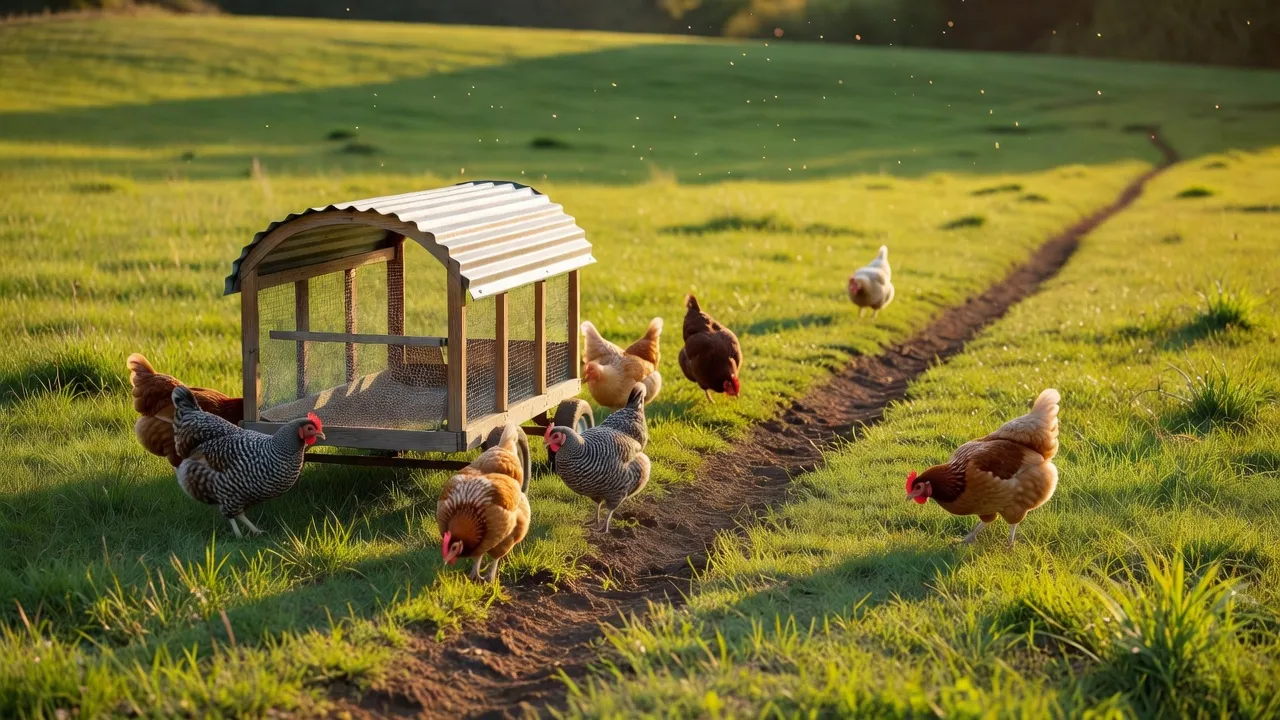
A chicken tractor is a light pen you move every day or two over fresh ground. A coop on wheels is a heavier house, paired with a run or free-range time, that you move less often. Both are “portable,” and the difference decides what size to buy.
Extension numbers for tractors come from meat birds. Penn State moves broiler tractors every 2 to 3 days in the first week on pasture, daily in weeks 5 and 6, and twice a day in weeks 7 and 8. Its rule for any tractor is to move it once half the pasture is used. Oregon State moved its orchard tractors every 2 to 3 days with 25 broilers in each.
Hens are different because they live in the pen for years, not weeks. I would size a hen tractor like a permanent coop with a run and use Penn State’s half-the-grass rule to decide when to move it.
Size per bird
Size the floor for how long the birds stay in it. Hens that live in the pen need Cornell’s 6.5 to 8.5 square feet each. Meat birds on a short grow-out in a daily-move pen need 1.5 to 2.
Extension housing rules come in two layers. Penn State asks for 1.5 square feet inside and 8 in the run per laying hen, 2 and 10 for large chickens. Penn State’s pastured broiler guide uses 1.5 square feet per bird for tractors and Oregon State uses 1.5 to 2. Penn State’s Salatin-style tractor is about 10 feet wide by 12 feet long by 2 feet high and holds about 80 birds. Its A-frame is about 5.5 by 10 feet and holds about 36.
| Floor area | Hens that live in it (6.5 to 8.5 sq ft) | Meat birds on a daily move (1.5 to 2 sq ft) |
|---|---|---|
| 18.5 sq ft (Aivituvin AIR61) | 2 to 3 | 9 to 12 |
| 30 sq ft (5 by 6 ft) | 4 to 5 | 15 to 20 |
| 50 sq ft (5 by 10 ft) | 6 to 8 | 25 to 33 |
| 120 sq ft (10 by 12 ft) | 14 to 18 | 60 to 80 |
The picks
Each card gives the maker’s claim, the floor area the page supports and the capacity the math supports. Gaps in the spec lists are gaps on the maker’s page.
Aivituvin AIR61 Mobile Chicken Tractor
2 or 3 hens on a small lawn, moved by hand
- Maker's capacity
- 2 to 3 chickens
- Inner space
- About 18.5 sq ft (retailer listings say 18.47)
- Moved by
- Two wheels and a handle, per retailer descriptions
- Nest box
- Two-section nest box
- Price
- Varies by retailer; not listed here
- The capacity claim matches the floor math: 18.5 square feet fits 2 to 3 hens that live in it
- Wheels and a handle for moving
- Retailer listings put it far below the other units here
- Only for 2 or 3 hens
- Retailer listings disagree on the width
- Price and stock differ between retailers
What owners report
Reviewers on Chewy include one who says the roof was already peeling and one who found it well made but smaller than expected. The maker's own AIR61 video shows the unit, but it is marketing, so weigh it that way.
Omlet Eglu Cube
a small flock that wants a ready-made coop with an optional attached run
- Maker's capacity
- Up to 10 chickens on the listing, 6 in the site menu
- Moved by
- Integrated handles and wheels, per the maker
- Run
- Optional, with or without
- Size, weight and price
- Not stated on the category page
- Sold with or without a run
- Maker says it moves on built-in handles and wheels
- The maker's own capacity figures disagree, 10 against 6
- No size, weight or price on the category page, so the floor math cannot be checked
- Ask for the interior floor area before you order
Mobile Chicken House Coop for 5 Chickens (5x6)
4 or 5 hens on a lawn or pasture you can roll the frame across
- Maker's capacity
- 5 chickens in the title; 'up to 12 birds' in the description
- Frame
- 5 ft x 6 ft, about 30 sq ft
- Material
- Aluminum frame, Shelter Rite vinyl cover
- Netting
- 1 in x 1 in, 14-gauge galvanized, welded after weaving
- Moved by
- Adjustable wheel system
- Floor
- Not stated
- Delivery
- Kit; assembly required
- The 1-inch netting is inside Colorado State's '1-by-2-inch or smaller' line
- Aluminum frame and a wheel system built for moving
- Title capacity of 5 is close to the floor math
- The page claims both 5 and up to 12 birds; 12 is under 3 square feet each
- Floor type is not stated
- Kit assembly adds time
Happy Farmer 5x10 Mobile Coop
6 to 8 hens that live in the pen, or 25 to 30 birds on a short grow-out
- Maker's capacity
- 25 layers or 30 broilers; the description says 20 to 30 chickens
- Size
- 5 x 10 (no units on the page; about 50 sq ft if feet)
- Moved by
- Wheel details not stated for this model; the category page says 'easy-to-use wheels'
- Floor
- Not stated
- The maker separates layers from broilers
- 30 broilers is about 1.7 square feet each, close to extension's 1.5 to 2 for meat birds
- Priced below the 10 by 12 foot units
- 25 layers is 2 square feet each, a day-pen number rather than a living space
- Wheel details and floor type are not stated
- The page lists dimensions without units
Mobile Chicken House Coop for 40 Chickens (10x12)
a larger flock that rotates over pasture, 14 to 18 hens living in it or more birds on a short grow-out
- Maker's capacity
- Up to 40 chickens in the description; the features list says up to 60
- Frame
- 10 x 12 (no units on the page; about 120 sq ft if feet)
- Material
- Aluminum frame, Shelter Rite vinyl cover, 1 in x 1 in 14-gauge galvanized netting
- Moved by
- Adjustable wheel system
- Add-ons
- Rollaway nest box and roosting system, $584
- Delivery
- Kit; assembly required
- Large floor area for rotational grazing
- Same 1-inch welded netting as the smaller unit
- Optional nest box and roosting system
- The page claims 40 and 60 birds, which is 3 and 2 square feet each
- Nest box and roosting system cost extra
- Floor type is not stated
Pros and cons of going portable
A portable coop gives hens fresh ground and costs you the effort of moving it. That trade is worth it on grass you want fertilized and not worth it on a flock you will not move.
What portable does well
- Fresh grass and bugs for the hens
- Manure spreads across the lawn instead of piling up under a fixed run
- Penn State says a tractor shades birds, keeps them dry and breaks the wind
- A tractor works as a day-pen for a flock that sleeps in a fixed coop
What to weigh
- Moving it is work, and a heavy unit stops getting moved
- Predator access under the frame and through the wire
- Small floor area compared with a fixed coop and run
- Weak in deep cold or heavy snow
Owners say the same. A Facebook group thread on portable tractor pros and cons for 6 hens lists fresh grass and bugs as the pros and difficulty moving and predator access as the cons. Another member asks for an aluminum tractor to move 10 hens from a full-time coop to different free-range areas. That is the use I think suits a tractor best: a day-pen on grass, with a fixed coop for nights and winter.
Predator gaps under the frame
The predator weak points on a portable coop are the gap between frame and ground, the wire mesh and the lid. Close all three, or the wheels do not matter.
Colorado State Extension says you will lose fewer birds with 1-by-2-inch mesh or smaller welded wire. It adds hawk cover over a run, whether welded wire, chicken wire or game-bird netting, and says to shut hens in at night. Penn State says a tractor protects birds from predators, and in high-predator areas it surrounds the field with electric net fencing to stop animals from digging under, reaching through or tearing the wire.
Fencing alone does not close the ground gap. In Oregon State’s orchard trial, layers sat inside 48-inch electric netting with a low coop, and the predation rate on layers approached 37% by March. The article says the electric fence did not prevent the loss of layers to ground-based predators. Hawks, foxes and raccoons were the main predators.
Owners ask about the same gap. Two r/BackYardChickens threads, Chicken Tractor and Rodent Problem? and Rat wire on the bottom of a chicken tractor?, are worth reading before you pick a floor.
My checklist for any portable coop:
- Keep the frame on level ground so rocking on a slope does not leave a gap underneath.
- Hardware cloth where a hand can reach. The hardware cloth guide covers gauge and mesh.
- Train the hens to go in at dusk, then lock the door once they are inside.
- Add a skirt or floor to protect against digging predators. The predator-proofing guide explains skirts and where to bury wire on a fixed run.
Weight, wheels and moving
Weight is the spec makers publish least, and it decides whether you move the coop at all. None of the pages above state a weight for these portable units, so ask before you buy.
Oregon State’s broiler tractor measured 10 feet by 4 feet by 2 feet. It used lightweight PVC framing and chicken wire, and the article notes PVC is lighter than wood but needs more structural support. Penn State’s A-frame is tall enough to walk into, which makes feeding easier. A tall frame also catches wind, so stake it down.
The wheel details differ by maker. The Mobile Chicken House units have an adjustable wheel system. Aivituvin’s AIR61 has two wheels and a handle. Happy Farmer’s 5 by 10 does not state its wheels, though the category page says the coops have easy-to-use wheels. Omlet says its coops move on integrated handles and wheels.
One r/homestead thread, Overbuilt my mobile chicken coop - build a separate lightweight summer coop?, is the standard warning: a coop that is hard to move does not get moved.
Build your own tractor
A DIY tractor costs less than most of the units above, and the extension designs are public. Penn State describes two: a Salatin-style low pen of about 10 by 12 feet and a walk-in A-frame of about 5.5 by 10 feet. Oregon State used a 10 by 4 by 2 foot PVC tractor with a three-sided shelter end. The Joel Salatin broiler shelter video walks through the classic design.
Use the floor-area table above to size it. If hens will live in it, cover the vents and any gap a paw can reach with hardware cloth, and do not skimp on the lid.
When a portable coop is the wrong choice
A portable coop is the wrong choice for hens that need a warm, ventilated house through a hard winter. None of the spec lists above shows a snow-load or insulation rating, so for cold climates a fixed coop with a fenced run is the safer buy. The coop kits guide covers fixed options, and the winter ventilation guide covers what a cold-weather coop needs.
Questions people ask
How often do you move a chicken tractor?
For meat birds, Penn State Extension moves the tractor every 2 to 3 days in the first week on pasture, daily in weeks 5 and 6, and twice a day in weeks 7 and 8. It also says to move once half the pasture is used. Oregon State moved its orchard tractors every 2 to 3 days. For hens that live in the pen, I would use Penn State's half-the-grass rule and move before the ground shows.
How many chickens fit in a portable coop?
Hens that live in the pen need about 6.5 to 8.5 square feet each, which is Cornell's 2.5 to 3.5 inside plus 4 to 5 outside. A tractor with 18 square feet fits 2 to 3 hens. Extension numbers for meat birds on a daily move are 1.5 to 2 square feet, so the same 18 square feet holds 9 to 12 broilers for a few weeks.
Do I need a run with a portable coop?
If it is a tractor, the pen is the run, so size the whole floor for the hens. If it is a coop on wheels that only shelters hens at night, add a run. Penn State asks for 8 square feet of run per laying hen and 10 for large breeds. The run planning guide covers the details.
Are portable chicken coops safe from predators?
Only if the wire, the lid and the ground gap are closed. Colorado State Extension says you lose fewer birds with 1-by-2-inch mesh or smaller. A tractor sits on bare ground, so a gap under the frame is the weak point. The predator-proofing guide covers skirts and latches.
Sources
- Penn State Extension: Small-scale poultry housing
- Cornell Cooperative Extension Warren County: Backyard chickens
- Penn State Extension: A quick guide to raising pastured broilers
- Oregon State University Extension: Chicken tractors (EM 9320)
- Colorado State University Extension: Chickens and predators
- Mobile Chicken House: Chicken Coop for 5 Chickens
- Mobile Chicken House: Chicken Coop for 40 Chickens
- Happy Farmer: Mobile coops
- Omlet: Portable chicken coops
- Home Depot: Aivituvin AIR61 mobile chicken tractor listing

Written by Kyle
Kyle has kept backyard chickens on his own small farm for five years. He reads the extension research, the spec sheets and the owner complaints, then tells you what he would buy and what he would skip.