On this page
- Quick picks
- How I chose these brooders
- Space per chick by week
- Best complete kit: Cozy Chickens Brooder Habitat Plus
- Best heat plate for a DIY brooder box: Brinsea EcoGlow Safety 600
- Best DIY setup: a box you already have, plus a plate
- Best for larger batches: Brinsea EcoGlow Safety 1200
- Kit or DIY: which should you buy?
- Bedding that works and bedding that does not
- The temperature schedule in one line
- Heat plate or heat lamp
- Brooder setup checklist
The best chick brooder box is the one with enough floor: 0.5 sq ft per chick until week 4 and 1 sq ft until week 8, per UMaine Extension. Six chicks need 3 sq ft at first and 6 sq ft by week 4, so a 2 x 3 ft box carries a small batch to week 8. Heat is the second purchase. A 12 W heat plate costs about $2 in power over six weeks and a 250 W lamp about $46 at the EIA’s 18.16 cents per kWh, so I’d buy a plate for a DIY box or a heated kit for a small batch. Prices below were checked 2026-10-09. This page is part of the chick brooder guide.
Quick picks
Pick by chick count first, then by how much you want in one box. The chick counts are the makers’ own. The floor-space section below shows where they run past the extension numbers.
| Pick | Best for | Heat | Maker’s chick count | Price, checked 2026-10-09 |
|---|---|---|---|---|
| Cozy Chickens Brooder Habitat Plus | Best complete kit | 36 W heated dome | Up to 20 | $109.99 |
| Cozy Chickens Brooder Habitat | Smaller kit | Heated hood, watts not listed | Up to 14 | $99.99 |
| Brinsea EcoGlow Safety 600 | Best heat plate for a DIY box | 12 W plate | About 20 newly hatched | $79.99 sale, $99.99 regular |
| Brinsea EcoGlow Safety 1200 | Best for larger batches | 18 W plate | About 35 newly hatched | $111.99 sale, $139.99 regular |
| Tote, trough or cardboard box plus a plate | Cheapest way to scale | Your plate | Set by floor space | Box price varies |
Stock changes. On 2026-10-09 the Cozy Products pages showed both kits as sold out, so check before you plan around one. The Chickcozy Smart Coop Heater & Brooder ($79.99) is the other plate worth a look, and it has its own entry in the heat plate roundup. Retail brooders overall run from $34.99 to $499.99 on My Pet Chicken’s brooder page.
How I chose these brooders
I compared maker spec pages and extension brooding bulletins, then checked each maker’s chick count against extension floor-space numbers. I have not run a controlled comparison of any of these brooders. Every spec below is the maker’s or an extension service’s, with the source linked, and the method is on the how we research page. What mattered most:
- Floor space: does the box or kit give your chick count room by week 4?
- Heat: the wattage, the safety listing, and whether a bulb hangs over bedding.
- Honest counts: does the maker separate newly hatched chicks from older ones?
- Price: checked 2026-10-09, with the regular price noted when a sale is running.
Space per chick by week
Give each chick 0.5 sq ft until week 4, 1 sq ft from week 4 to 8 and 2 sq ft from week 8 to 12, per UMaine’s Table 1. Multiply by your chick count.
| Chicks | To week 4 (0.5 sq ft each) | Weeks 4 to 8 (1 sq ft each) | Weeks 8 to 12 (2 sq ft each) |
|---|---|---|---|
| 4 | 2 sq ft | 4 sq ft | 8 sq ft |
| 6 | 3 sq ft | 6 sq ft | 12 sq ft |
| 10 | 5 sq ft | 10 sq ft | 20 sq ft |
| 15 | 7.5 sq ft | 15 sq ft | 30 sq ft |
| 25 | 12.5 sq ft | 25 sq ft | 50 sq ft |
Six chicks need 3 sq ft at first, about 1.5 x 2 ft, and 6 sq ft from week 4, a 2 x 3 ft box. Ten chicks need 5 sq ft, then 10. Twenty-five chicks need 12.5 sq ft before week 4, which is a pen or a large trough, not a tote. Add feeder and waterer room too: 1 inch of feeder and 0.5 inch of waterer per chick to week 4, so six chicks need 6 inches of feeder and 3 inches of waterer.
The sources disagree a little, and the disagreement runs toward tighter. Penn State Extension allows 1/4 sq ft in week 1, 1/2 sq ft in weeks 2 and 3, 3/4 sq ft in weeks 3 to 5 and 1 sq ft in weeks 5 to 8. Cornell Cooperative Extension in Warren County describes a 2 x 3 ft box, 18 inches deep, for 25 chicks. That works out to about 0.24 sq ft each, the same as Penn State’s week 1 number and half of UMaine’s. I’d plan on UMaine’s larger allowance. Crowding is cheap to prevent and annoying to fix after week 2.
Sides need to be 12 to 18 inches high to hold the chicks and stop drafts, says Alabama Extension. Alabama also warns that corners pull chicks away from the heat, and Purdue Extension says a circular boundary of cardboard or mesh cuts huddling and suffocation losses. I’d drop a cardboard ring into a square tote.
Best complete kit: Cozy Chickens Brooder Habitat Plus
The Cozy Chickens Brooder Habitat Plus is the best complete kit for a first batch of about 6 chicks. It bundles a 36 W heated dome, a central water tube and a feed dish with a splash guard, and the maker rates it for up to 20 chicks at $109.99 (Cozy Products).
Do the floor math before you trust the 20. The maker lists a 16.5 inch diameter, which is about 1.5 sq ft if all of it is floor. At Penn State’s 1/4 sq ft for week 1 that fits about 6 chicks, and at UMaine’s 0.5 sq ft it fits about 3. I’d plan on 6 or fewer chicks in the base and ignore the 20.
Cozy Chickens Brooder Habitat Plus
a first batch of about 6 chicks, with heat, water and feed in one unit
- Power
- 36 W, 24 V
- Maker's chick count
- Up to 20
- Size
- 16.5 in diameter, 13.75 in high
- Cord
- 72 in
- Included
- Heated dome, water tube, feed dish with splash guard
- Safety listing
- ETL
- Heat, water tube and feeder in one unit
- 36 W, a fraction of a 125 W or 250 W lamp
- ETL safety listed
- The listed 16.5 in footprint is about 1.5 sq ft, small for 20 chicks by extension floor-space numbers
- Plan a bigger box by week 4, when UMaine's allowance doubles to 1 sq ft per chick
- The maker's page showed it sold out on 2026-10-09
The plain Cozy Chickens Brooder Habitat costs $10 less at $99.99. It supports up to 14 chicks and has an adjustable heated hood that you raise as the chicks grow. The maker’s page does not list its wattage, and wattage is the number I want before I buy heat. I’d pay the $10 for the Plus.
Cozy Chickens Brooder Habitat
a small first batch when you want a hood you can raise
- Power
- 120 V, wattage not listed
- Maker's chick count
- Up to 14
- Size
- 15.56 in wide, 11 in high, 10 in deep
- Cord
- 72 in
- Heat
- Adjustable heated hood
- Safety listing
- cETL US
- Hood raises as the chicks grow
- Safety listed
- $10 under the Plus
- Wattage is not listed on the maker's page
- The page does not list what is in the box
- The maker's page showed it sold out on 2026-10-09
Best heat plate for a DIY brooder box: Brinsea EcoGlow Safety 600
The Brinsea EcoGlow Safety 600 is the heat plate I’d put in a DIY box for 6 to 20 chicks. It draws 12 W, Brinsea rates it for about 20 newly hatched chicks or 10 to 12 older ones, and it costs $79.99 on sale ($99.99 regular), per Brinsea’s product page. Over six weeks of nonstop running it uses about 12 kWh, around $2.
A plate warms the chicks, not the air. Brinsea says to set the legs near 3 inches for standard-sized chicks, lower the plate if they huddle and raise it if they pant (Brinsea). The full method is in the heat plate roundup and the numbers are in the temperature chart.
Brinsea EcoGlow Safety 600
a DIY box for 6 to 20 chicks
- Power
- 12 W, 12 V (transformer supplied)
- Maker's chick count
- About 20 newly hatched; 10 to 12 older chicks
- Size
- 9 x 8 x 12 in (H x W x D)
- Height
- Four adjustable legs
- Warranty
- 3 years
- Use
- Indoor only, room above 50°F
- 12 W is about $2 of power over six weeks
- Legs set the height as the chicks grow
- Maker separates newly hatched from older chick counts
- Warms chicks, not the air, so a thermometer will not tell you much
- Indoor only, and the room must stay above 50°F
- Capacity roughly halves for older chicks
Best DIY setup: a box you already have, plus a plate
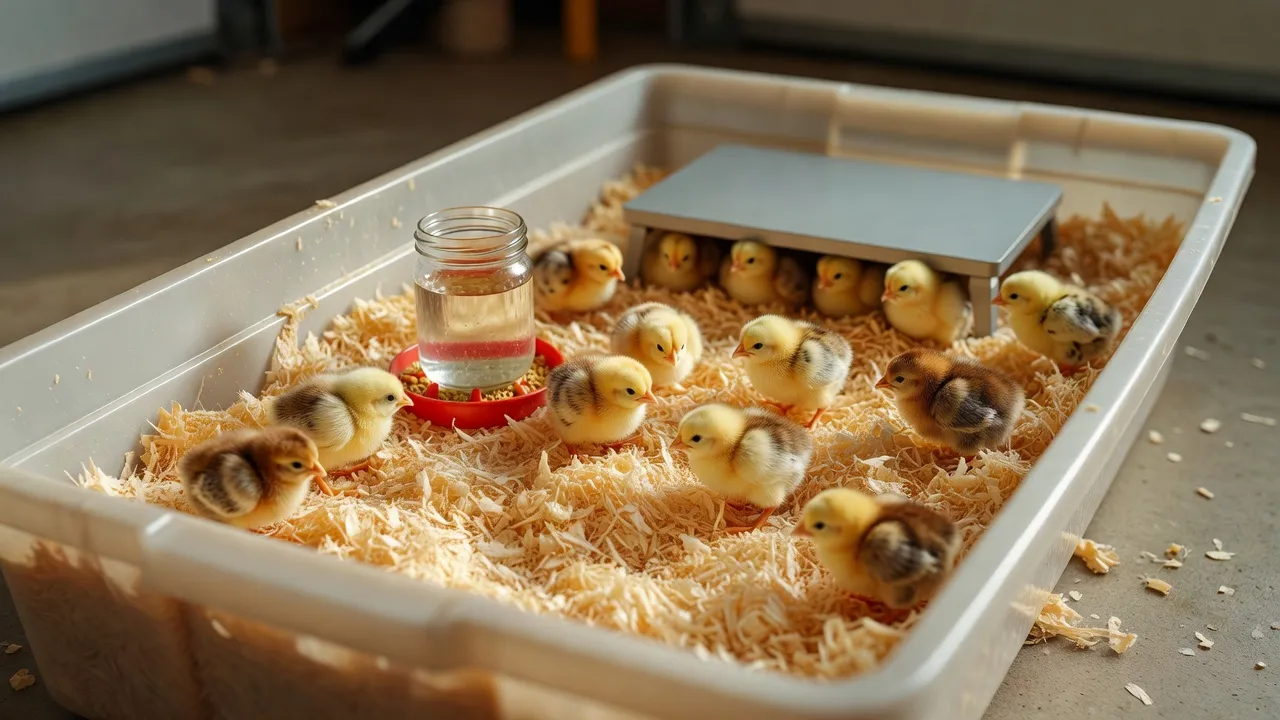
The cheapest brooder that follows the extension rules is a box with 12 to 18 inch sides, 2 to 4 inches of pine shavings, a heat plate, a feeder and a waterer. Alabama Extension says a cardboard box works for a small flock and a larger container, such as a water trough, works for more. UMaine specifies 2 to 4 inches of clean, dry litter.
The cost is the box plus the plate. A plate runs $79.99 for the Brinsea 600 or $59.95 for the RentACoop 12x12 in the heat plate roundup, and you reuse it every batch. The box price depends on what you grab, so I leave it off the math. Size it from the table above, add a ring if the corners are square, and cover the top once the chicks start hopping.
Best for larger batches: Brinsea EcoGlow Safety 1200
The Brinsea EcoGlow Safety 1200 is the plate for 15 to 30 chicks. It draws 18 W, Brinsea rates it for about 35 newly hatched chicks or 20 to 25 older ones, and it costs $111.99 on sale ($139.99 regular) per Brinsea. Brinsea does not recommend placing more than four EcoGlow brooders together (Brinsea), so a very large batch needs more than a pile of plates.
A batch this size changes the box, not just the heat. Fifteen chicks need 7.5 sq ft before week 4 and 15 sq ft by week 8. That is a pen or a trough with a ring, and the plate sits at one end so chicks can get away from it.
Brinsea EcoGlow Safety 1200
15 to 30 chicks in a pen or trough
- Power
- 18 W, 12 V (transformer supplied)
- Maker's chick count
- About 35 newly hatched; 20 to 25 older chicks
- Size
- 9 x 12 x 17 in (H x W x D)
- Warranty
- 3 years
- 18 W is about $3 of power over six weeks
- Covers a batch a 12 W plate cannot
- Same low-voltage design as the 600
- About $32 more than the 600 on sale
- Needs a big box to match the chick count
- Indoor only, like the 600
Kit or DIY: which should you buy?
Buy a kit if you are raising about 6 chicks or fewer and want heat, water and feed in one unit. Build a DIY box for anything bigger. A kit costs $99.99 to $109.99 and its footprint caps the batch. A DIY box costs the plate ($59.95 to $79.99), a box, a feeder and a waterer, and it grows when the batch does. For 10 or more chicks the kit footprint stops making sense, and the DIY box with a Brinsea plate wins on both floor space and running cost.
Bedding that works and bedding that does not
Use pine shavings, 2 to 4 inches deep. Alabama Extension says shavings absorb droppings and keep chicks warm. Newspaper is too slick and can cause splayed legs, sand is too cold, and straw and hay do not absorb. UMaine rules out hardwood shavings and hay too. Bad bedding causes leg problems and chills chicks, so this is a place to spend two extra minutes. UMaine’s other bulletin recommends paper towels or burlap for the first week or two, then looser bedding such as pine shavings or ground corncobs.
Not vet advice
If chicks show splayed legs, turn lethargic or die in numbers even when the heat and bedding look right, call a vet who treats poultry or take them to your state diagnostic lab. Alabama Extension gives that advice for excessive losses.
The temperature schedule in one line
Heat runs 95°F at chick level in week 1, then drops 5°F a week to 70°F (UMaine, Alabama). That is 95, 90, 85, 80, 75 and 70°F across six weeks. A plate does not heat the air, so the chicks’ behavior replaces the thermometer. The full brooder temperature chart has the ranges and the behavior cues.
Heat plate or heat lamp
Both work, and they fail differently. Alabama Extension lists a 125 or 250 W heat lamp as the standard brooder heat, measured 2 inches above the bedding. A lamp over bedding is the part that worries me, and UMaine names a heating pad or flat panel as a safer option.
If you hang a heat lamp
UMaine wants a porcelain fixture on a chain, hung 18 to 20 inches above the bedding and never closer than 15 inches. Penn State wants lamps at least 20 inches from anything flammable.
Power is the other gap. Six weeks is 1,008 hours at the EIA’s 18.16 cents per kWh.
| Heat source | Watts | Six weeks, nonstop | Cost at 18.16 cents |
|---|---|---|---|
| 250 W heat lamp | 250 | 252 kWh | about $46 |
| 125 W heat lamp | 125 | 126 kWh | about $23 |
| Cozy Habitat Plus | 36 | 36 kWh | about $7 |
| Brinsea EcoGlow 1200 | 18 | 18 kWh | about $3 |
| Brinsea EcoGlow 600 | 12 | 12 kWh | about $2 |
Brooder setup checklist
Set it up the day before the chicks arrive. Alabama Extension says the brooder takes about 24 hours to reach the right temperature.
- Choose a box with enough floor space for week 4, sides 12 to 18 inches high, and a cardboard ring if the corners are square.
- Add two to four inches of pine shavings (UMaine). No newspaper, sand, straw or hay (Alabama).
- Turn the heat on 24 hours early. Put a thermometer at chick level, 2 inches above the bedding, if you are using a lamp.
- Place feed and water at the edge of the warm zone, not under the heat source, so chicks do not overheat or chill to eat (Alabama).
- Keep the water mild. Alabama puts the ideal water temperature under 77°F and suggests marbles in the waterer base so chicks do not drown.
- Dip each beak in water, then feed, as soon as the chick goes in.
- Check the chicks several times a day. Huddled means cold, spread out means right, panting and hugging the walls means hot. The temperature chart has the weekly targets.
- Plan the exit. Chicks that outgrow the brooder need a coop, and the coop kit picks cover your options.
Questions people ask
How big should a brooder be for 6 chicks?
Six chicks need 3 sq ft until week 4 (0.5 sq ft each) and 6 sq ft from week 4 to week 8 (1 sq ft each), per UMaine Extension. A 2 x 3 ft box is 6 sq ft, so it carries six chicks to week 8. Make the sides 12 to 18 inches high (Alabama Extension).
How long do chicks stay in a brooder?
Heat runs about six weeks on the extension schedule: 95°F in week 1, down 5°F a week to 70°F (UMaine Extension). Alabama Extension says to keep stepping down until the chicks are comfortable at the temperature of the coop they are moving to. Space can end the brooder first, because the allowance doubles to 1 sq ft per chick at week 4. The temperature chart has the week-by-week numbers.
Heat plate or heat lamp?
A heat plate costs far less to run and has no bulb to fall into bedding, so I'd pick a plate for a small backyard batch. A 12 W plate uses about $2 of power over six weeks and a 250 W lamp about $46 at 18.16 cents per kWh (EIA). Extension bulletins still list lamps as the standard, so if you use one, follow the hanging rules in the heat plate guide.
What bedding is best in a brooder?
Pine shavings. Alabama Extension says they absorb droppings and keep chicks warm, while newspaper is too slick and can cause splayed legs, sand is too cold, and straw and hay do not absorb. UMaine suggests paper towels or burlap for the first week or two, then shavings.
Sources
- UMaine Extension Bulletin 2219: Giving Chicks a Good Start
- Alabama Extension ANR-2920: Brooding Tips for Successful Bird Performance
- Penn State Extension: Brooding of Domestic Fowl
- UMaine Extension Bulletin 2221: Simple Steps to Starting Healthy Chicks in Maine
- Purdue Extension AS-527: A Guide for Housing, Brooding and Handling Chicks Safely
- Cornell Cooperative Extension Warren County: Backyard chickens
- Cozy Products: Cozy Chickens Brooder Habitat Plus (maker's product page)
- Cozy Products: Cozy Chickens Brooder Habitat (maker's product page)
- Brinsea EcoGlow Safety 600 (maker's product page)
- Brinsea EcoGlow Safety 1200 (maker's product page)
- Brinsea: Getting the best out of your EcoGlow brooder
- EIA Electric Power Monthly, Table 5.3: average residential price by state
- My Pet Chicken: Brooders collection (retail price range)

Written by Kyle
Kyle has kept backyard chickens on his own small farm for five years. He reads the extension research, the spec sheets and the owner complaints, then tells you what he would buy and what he would skip.