On this page
- The chick brooder temperature chart, week by week
- Why some hatchery charts say 100 to 105°F and extension says 95°F
- Day 1: what to set and what to watch
- Give chicks a warm zone and a cool zone
- Reading chick behavior
- Heat plates: use behavior, not a thermometer
- Where to put the thermometer and how to keep it steady
- When chicks can go without heat
Set the chick brooder temperature to 95°F at chick level for week 1, then lower it 5°F each week until it reaches 70°F in week 6. That is the schedule in UMaine Extension bulletin 2219, and Alabama Extension starts at 95°F and drops 5°F a week too. Chick level means 2 inches above the bedding, not your eye level. This page is part of the chick brooder guide.
Short answer
95°F, then 5°F lower each weekat chick level, down to 70°F by week 6
Measure 2 inches above the bedding, under the heat source. Huddled chicks are cold, so add heat. Panting chicks, or chicks staying away from the heat, are too hot, so cut it. The chicks overrule the chart.
The chick brooder temperature chart, week by week
Use the middle column as your target. The Purdue column shows the 5°F band that extension gives for each week, so you can see the target sits at its top.
| Week | Target at chick level | Purdue range | Note |
|---|---|---|---|
| 1 | 95°F | 90 to 95°F | Run the heat 24 hours before the chicks arrive. |
| 2 | 90°F | 85 to 90°F | Step down if the chicks are spread out. Hold if they huddle. |
| 3 | 85°F | 80 to 85°F | The heat keeps falling as feathers replace down. |
| 4 | 80°F | 75 to 80°F | Check corners and drafts. |
| 5 | 75°F | 70 to 75°F | Mississippi State says chicks hold their own temperature near a 70°F room by week 5. |
| 6 | 70°F | 70°F | End of the schedule. Switch the brooder off on warm days. |
In Celsius the targets round to 35, 32, 29, 27, 24 and 21°C. The targets come from UMaine and Alabama. Purdue’s Table I, given in days of age, supplies the Purdue column. Mississippi State Extension supplies the notes on feathers and the 70°F room, and says feathers replace the downy coat as chicks grow and the brooder temperature must fall with them.
Penn State Extension uses a looser table: 92 to 95°F in week 1, 85 to 90°F in weeks 2 and 3, 80 to 85°F in weeks 3 to 5 and 70 to 80°F in weeks 5 to 8. It lands in the same place by week 6 to 8, with slower steps.
Why some hatchery charts say 100 to 105°F and extension says 95°F
Valley Hatchery’s chart starts week 0 at 100 to 105°F, then runs 95 to 100°F, 90 to 95°F and 85 to 90°F for the next three weeks (Valley Hatchery). That sits 5 to 10°F above the extension rows. The extension sources are close to each other, and they leave room for a warmer first day:
- Purdue puts week 1 at 90 to 95°F and says to raise the schedule about 5°F during stress or vaccination.
- Alabama warms the brooder to 95 to 100°F before the birds arrive when chicks are lethargic.
- UMaine and Alabama both pick 95°F as the week 1 number.
My rule for day 1: aim for 95°F. If the chicks arrive tired from shipping, or they huddle at 95°F in a draft-free box, go to 100°F, which is inside what Alabama and Purdue describe, and drop back as they spread out. Do not run the whole week at 100°F or above. Overheated chicks eat and drink less (Alabama).
Day 1: what to set and what to watch
Day-old chicks cannot regulate their own temperature, so the first day is about having the heat ready (Alabama Extension). Do this in order:
- Start the heat 24 hours early and let the brooder settle at 95°F at chick level. Alabama says it takes about a day to reach temperature.
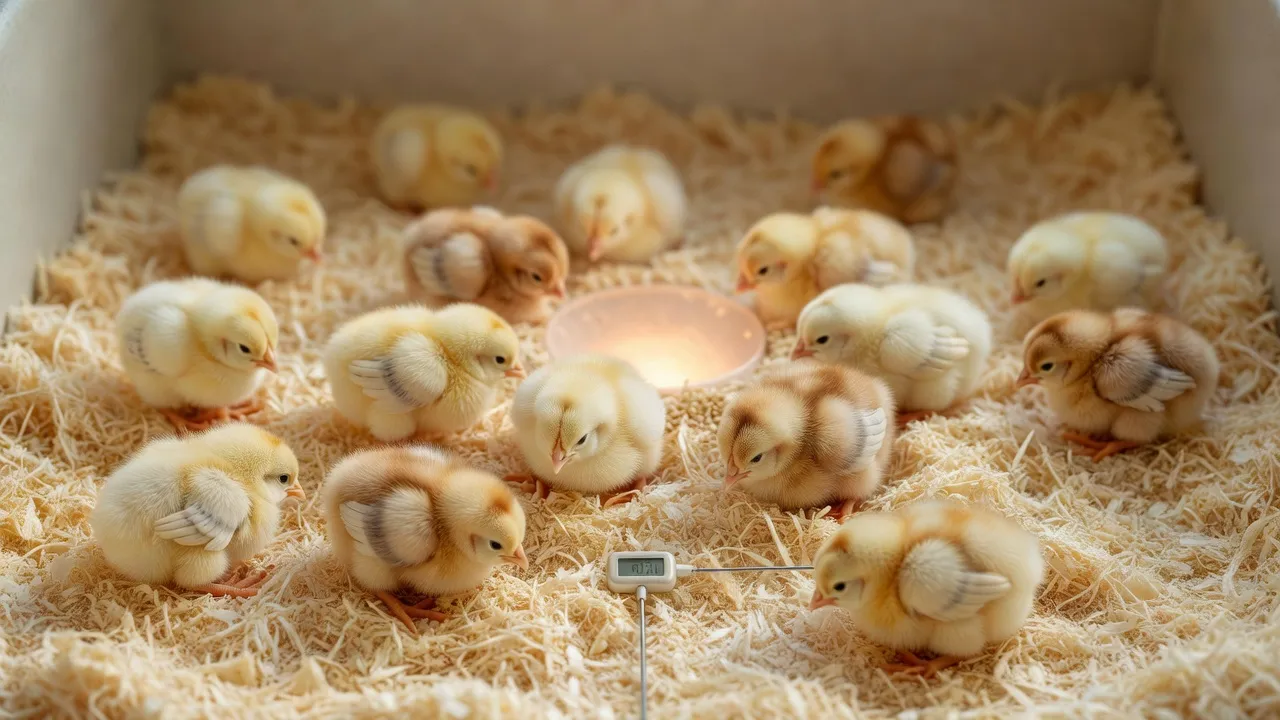
- Check the reading 2 inches above the bedding, under the heat source, with a thermometer you trust.
- Set water and feed first. Put the waterer and feeder at the edge of the warm zone, and keep the water under 77°F.
- Place the chicks and dip each beak in water, then feed.
- Watch for the first hour, then check every few hours. Spread out and eating means right. Piled up and chirping means add heat. Panting or away from the heat means cut it.
Keepers on r/BackYardChickens ask what to set for day 1. The answer is 95°F, then let the chicks’ behavior move it 5°F either way.
Give chicks a warm zone and a cool zone
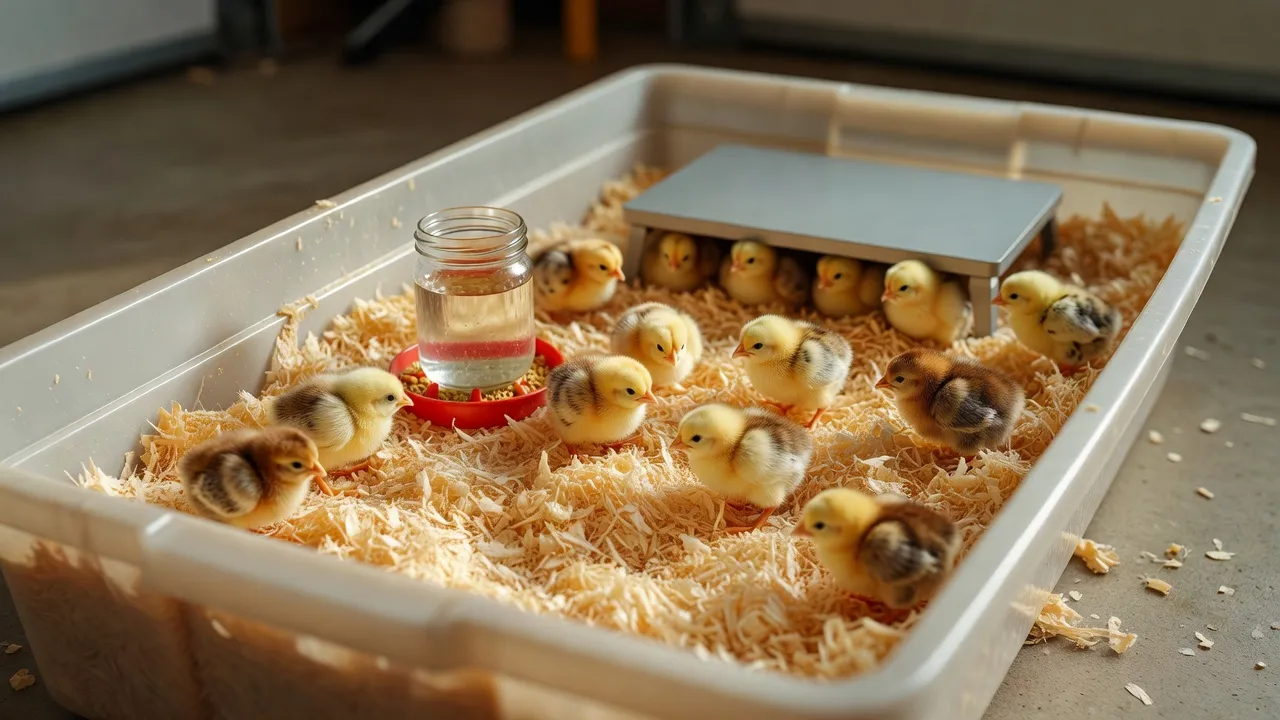
A brooder works best when chicks can walk out of the heat. Purdue Extension calls this localized brooding: a local heat source plus a cooler, unheated area, so chicks pick their own temperature by moving between them. The box needs to be big enough for that. UMaine wants 0.5 sq ft per chick to week 4, and the floor-space table works it out by chick count.
If every inch of the box is 95°F, chicks cannot get away from the heat, and the first sign of too hot is panting. Put the heat at one end and the feeder and waterer at the edge of its reach.
Reading chick behavior
A thermometer says what the air is doing, and the chicks say whether it works. Check them several times a day, especially in the evening.
| What you see | What it means | What to do |
|---|---|---|
| Huddled together under or beside the heat, chirping sharply | Too cold (UMaine, Alabama) | Add heat or lower the plate. Check for drafts. |
| Spread evenly around the heat, eating, drinking, sleeping | About right | Hold, then step down on schedule. |
| Panting, drowsy, or staying away from the heat | Too hot (Mississippi State) | Cut 5°F, or raise the lamp or plate. |
| Crowded to one side | Draft (Mississippi State) | Block the draft with a taller side or cover. |
| Gathered in a corner away from the heat | Corner crowding (Alabama) | Add a cardboard ring to round the corners. |
| Loud, not eating or drinking | Check temperature, feed and water | Alabama says noisy chicks are usually complaining about something. |
Chicks outside their comfort zone eat less, drink less and burn more energy keeping warm (Alabama). A temperature problem looks like a feed problem first.
Not vet advice
If chicks stay lethargic, will not eat or die in numbers when the temperature looks right, call a vet. Alabama Extension also says to take dead chicks to a state diagnostic lab when losses are excessive.
Heat plates: use behavior, not a thermometer
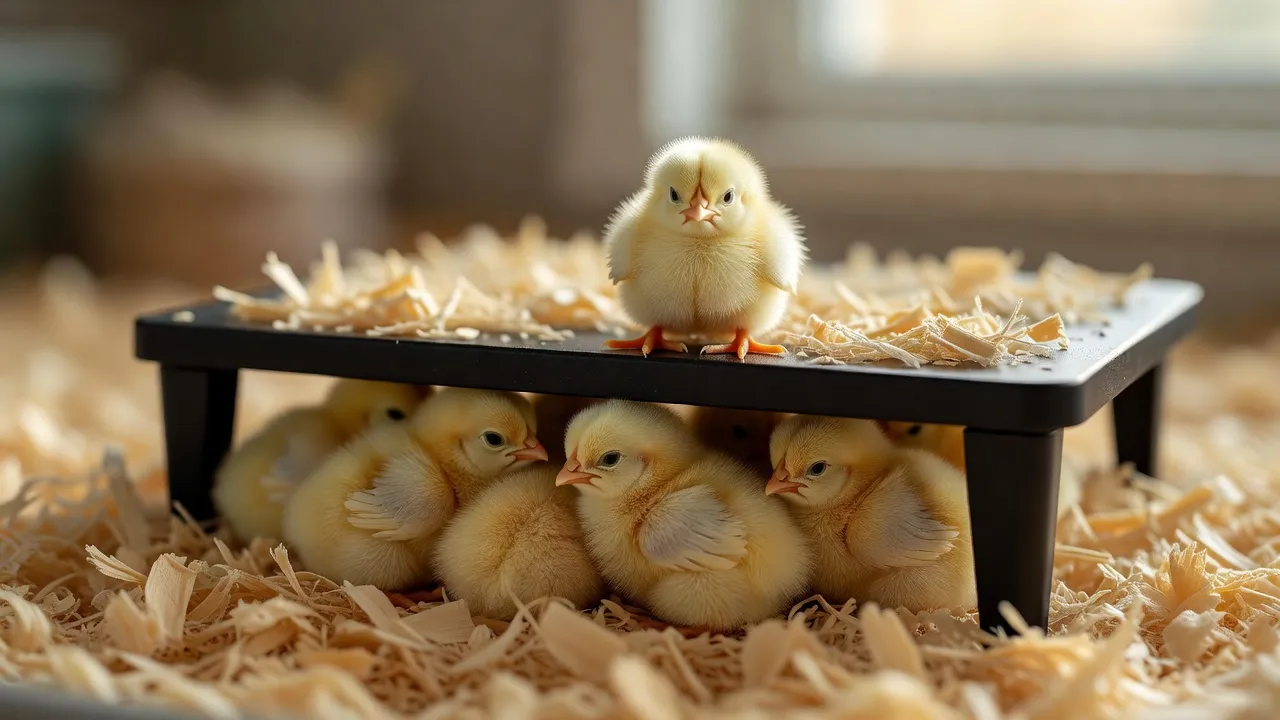
A heat plate warms the chicks under it and not the air, so the 95°F air-temperature chart does not apply directly. Brinsea says its plate “doesn’t heat the air” and that chicks’ behavior is the best indicator of comfort (Brinsea). Start the legs near 3 inches for standard-sized chicks, lower the plate if they huddle and raise it if they pant. Keep the room above 50°F (Brinsea).
The chart still helps with timing. It tells you the plate should climb a notch each week as chicks grow, and when the whole thing can come off. Some plates add a thermostat: Chickcozy lists a 70 to 95°F preset range for chicks and does not say where that temperature is read (Chickcozy). The heat plate roundup compares four of them.
Where to put the thermometer and how to keep it steady
- Put the probe 2 inches above the bedding under the heat source. Alabama says eye-level readings are easier to take but are not the number that counts.
- Purdue records the temperature about 2 inches from the floor, directly under the heat source.
- Purdue tells you to check the accuracy of brooder thermometers and thermostats. A second cheap one costs less than a lost batch.
- Alabama says to maintain it consistently, set for the chicks’ comfort and not yours.
- Keep them on the edge of the heat zone, not under it, so chicks do not overheat or chill to eat.
- Penn State says to avoid large temperature swings for the first 6 weeks.
When chicks can go without heat
On the UMaine schedule the heat reaches 70°F in week 6, and UMaine says you can turn the brooder off on warm days. The sources vary on the endpoint. Cornell Cooperative Extension in Warren County keeps the bulb on day and night for the first three weeks (Cornell). Penn State watches for chilling for six weeks and ends its table at room temperature in week 8. Alabama says to keep stepping down until the chicks are comfortable at the temperature of the coop where they will live.
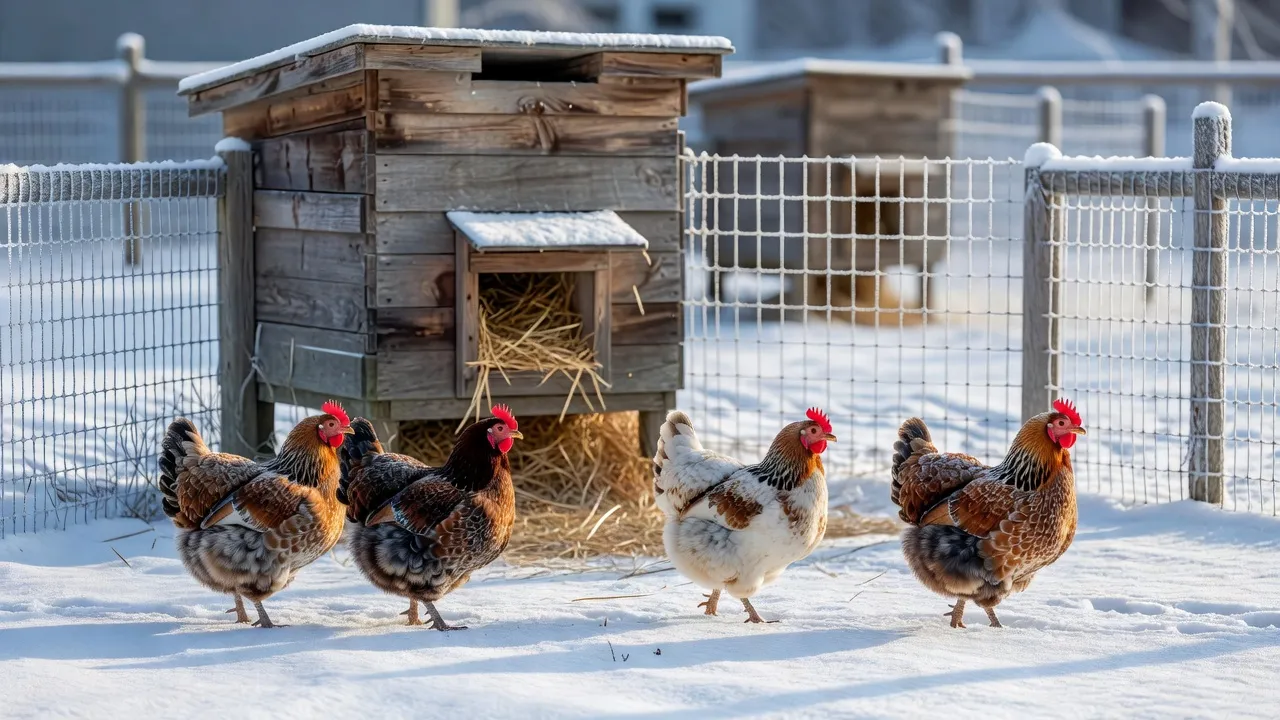
Across the sources that is three to six weeks of heat in mild weather, and longer when the coop is cold. If the move lands in winter, plan the coop heat before you plan the move. The heating a chicken coop guide covers it.
Questions people ask
What temperature should a brooder be for day-old chicks?
95°F at chick level, measured 2 inches above the bedding (UMaine Extension, Alabama Extension). Purdue gives a 90 to 95°F band for days 1 to 7. Some hatcheries start at 100 to 105°F. If chicks arrive lethargic, Alabama warms the brooder to 95 to 100°F, and the chicks' behavior decides from there.
When can chicks go without heat?
On the UMaine schedule the heat reaches 70°F in week 6, and UMaine says you can switch the brooder off on warm days. Alabama says to keep stepping down until the chicks are comfortable at the temperature of the coop they will live in, which takes longer in cold weather. Penn State says to avoid chilling chicks on cold nights or big swings for the first 6 weeks.
How do I know if my chicks are too hot or too cold?
Huddled together means cold. Spread evenly around the heat means right. Panting or staying away from the heat means too hot (UMaine, Alabama, Purdue). Chicks that pile on one side are dodging a draft.
Do I need a thermometer with a heat plate?
A plate warms the chicks and not the air, so Brinsea says a thermometer will not measure it and that behavior is the best indicator (Brinsea). Lower the plate if chicks huddle and raise it if they pant. Keep a thermometer for the room, which Brinsea wants above 50°F. The heat plate guide has the details.
Sources
- UMaine Extension Bulletin 2219: Giving Chicks a Good Start
- Alabama Extension ANR-2920: Brooding Tips for Successful Bird Performance
- Purdue Extension AS-527: A Guide for Housing, Brooding and Handling Chicks Safely
- Penn State Extension: Brooding of Domestic Fowl
- Mississippi State University Extension: Brooding Chickens and Quail
- Cornell Cooperative Extension Warren County: Backyard chickens
- Brinsea: Getting the best out of your EcoGlow brooder
- Valley Hatchery: Brooder temperature guide by week, 0 to 6 weeks (hatchery chart for comparison)

Written by Kyle
Kyle has kept backyard chickens on his own small farm for five years. He reads the extension research, the spec sheets and the owner complaints, then tells you what he would buy and what he would skip.